Radical Logo

|

DE

  • Home
  • Bestellung abgeschlossen
  • Blog / News
  • Blog / News
  • Buy Swiss Snowboards in the USA
  • Cart
  • Checkout
  • Company – About us
  • Contact us
  • Cookie Policy
  • Custom Made
  • Custom Made
  • Datenschutzerklärung
  • Dealer list
  • Dealer Login
  • Downloads
  • Downloads
  • Equipment
  • Firma – Über uns
  • Händler Login
  • Händlerliste
  • Homepage
  • Homepage
  • Kasse
  • Kontakt
  • Level of difficulty
  • Mein Konto
  • Miete und Testen – Kurse und Events
  • My account
  • One of ten Gallerie
  • One of ten Gallery
  • Our team
  • Privacy policy
  • RADICAL Geschichte
  • RADICAL Geschichte
  • Radical in den Medien
  • Radical in the media
  • Radical Sale
  • Rent and test – Courses and events
  • Repairs and service for skis and snowboards
  • Schwierigkeitsgrad
  • Service und Reparaturen von Ski und Snowboard
  • Shop
    • Equipment
    • Radical Sale
    • Radical Shop overview
    • Skateboard
    • Skis
    • Snowboard
    • Splitboard
  • Shopping cart
  • Skateboard
  • Skis
  • Snowboard
  • Splitboard
  • Technologie und Nachhaltigkeit
  • Technology and sustainability
  • TestDay
  • tickets Kasse
  • Tour offer
  • Tourenangebot
    • Anmeldung Stammmitglieder
  • Unser Team
  • Warenkorb
  • Allgemein
  • Allgemein @en
  • Company
  • Events
  • Events
  • Featured
  • Featured
  • Firma
  • Fotografie
  • Freeride and Touring
  • Freeride und Touren
  • Ski
  • Ski
  • Snowboard
  • Snowboard

🔍

Shop ist heute:

Geschlossen

Quick Links

  • Produktübersicht
  • Alle Touren und Events
  • Über uns

Radical Sports AG
Albisstrasse 143, 8038 Zürich
Email: mail to Radical Sports
Phone: +41 44 483 00 37

Splitboard Guide – ein Qualitätsprodukt

Splitboard Guide – ein Qualitätsprodukt

Allgemein, Allgemein @en, Freeride and Touring, Freeride und Touren

Ein Splitboard Guide ist mehr als nur jemand, der die Spur anlegt. Er steht für Qualität, Erfahrung und Verantwortungsbewusstsein – für ein sicheres, intensives und inspirierendes Erlebnis in den Bergen.

Bei Radical arbeiten wir ausschliesslich mit geprüften Splitboard Guides zusammen. Sie bringen nicht nur das nötige Fachwissen und die Erfahrung mit, sondern teilen auch unsere Haltung: Sicherheit, Respekt und Freude am gemeinsamen Unterwegssein stehen im Mittelpunkt.

Der Guide - Qualität, Kompetenz, Verantwortung

Uns geht es dabei nicht um Abgrenzung, sondern um Austausch. Jeder, der mit Gruppen im Winter unterwegs ist – ob Bergführer, Schneesportlehrer, J&S-Leiter oder SAC‑Guide – trägt Verantwortung und leistet einen Beitrag zu einer lebendigen Bergkultur. Wenn Informationen geteilt werden, statt verloren zu gehen, profitieren alle: die Natur, die Anbieter und vor allem die Gäste.

Der Gast im Fokus

Die zentrale Frage jeder Tour lautet: Was will mein Gast – und was kann er?
Ein Freerider sucht andere Linien als ein klassischer Tourengeher. Ein Einsteiger will Sicherheit und Vertrauen, ein erfahrener Rider Herausforderung und Flow. Gute Guides spüren diese Unterschiede und gestalten die Tour entsprechend. Das macht den Unterschied zwischen einer Tour und einem Erlebnis.

Sicherheit als Grundwert

Sicherheit ist kein Nebenthema, sondern die Basis jeder Tour.
Bergsport bleibt immer mit Risiken verbunden – das ist Teil seiner Faszination. Ein guter Guide erkennt Gefahren frühzeitig, trifft klare Entscheidungen und sorgt dafür, dass die Freude im Vordergrund bleibt. Erfahrung, Wissen und Ruhe sind dabei entscheidend.

Qualität schafft Vertrauen

Ein geprüfter Splitboard-Guide steht für Professionalität. Dazu gehört auch die Haftpflichtversicherung, die im Ernstfall Schutz bietet – ein Aspekt, den viele unterschätzen. Kommerzielle Angebote ohne offizielle Befugnis sind nicht nur rechtlich heikel, sondern auch für Gäste ein Risiko, auf Versicherungsschutz zu verzichten.

Unterschiede zwischen Splitboarden und Skitouren?

Splitboarder gehen ihre Touren anders an als klassische Skitourengänger. Sie wählen die Spur im Aufstieg oft etwas breiter, gleichmässiger und mit weniger Spitzkehren. In der Abfahrt suchen sie Linien mit viel Flow und Platz für Turns, während Skitourengänger manchmal direkter oder technischer fahren. Splitboarder bevorzugen Hänge mit richtig viel Spassfaktor, Pulver und Abfahrten, die sich lohnen. Auch flache Passagen werden möglichst vermieden, weil man dort nicht rausstöckeln kann wie mit Ski. Deshalb bieten wir spezielle Touren an, die genau auf diese Bedürfnisse abgestimmt sind.

Anspruch, Niveau und Erlebnis

Jede Tour ist individuell – so wie die Menschen, die daran teilnehmen.

Was für den einen anstrengend ist, ist für den anderen ein lockeres Warm-up. Der Schlüssel liegt darin, das richtige Niveau zu treffen und die Gruppe sicher, motiviert und mit Freude ans Ziel zu führen.

Ein Splitboard Guide ist damit weit mehr als ein Tourenleiter. Er ist Coach, Sicherheitsmanager, Routenplaner und Motivator in einem – kurz gesagt: ein Qualitätsprodukt.
Die zentralen Fragen für jeden Tourenführer, egal ob Bergführer, Schneesportlehrer, J&S-Leiter oder SAC Guide lauten also: Was will mein Kunde?


Der Guide - Ein Qualitätsprodukt

Wir wollen in diesem Blog gar nicht einen Gewinner ermitteln, sondern die Feinheiten vom verschiedenen Führen darlegen und auch gleich Lösungen anbieten.

Jeder geprüfte Tourenführer hat so seine Eigenarten beim Führen. Eins haben aber sicher alle gemeinsam. Die Sicherheit beim Touren. Bergsport ist gefährlich und immer mit Risiken verbunden. Die Lawinengefahr ist nur eine der vielen Gefahren. Die Idee eines guten Risikomanagements besteht darin, die Teilrisiken aufzuspüren, zu strukturieren, zu quantifizieren und das Gesamtrisiko abzuschätzen – das freilich nie auf null reduziert werden kann. Ziel ist der bewusste Umgang mit den grössten Risiken. Auf Ski- und Snowboardtour sind dazu laufend verschiedene Überlegungen, Massnahmen und Tätigkeiten erforderlich. Das braucht Wissen und Erfahrung. Alles, was ein guter Guide mitbringen soll. Top, wenn auch die Nachhaltigkeit, der Charakter und die Finanzierung passen. Der Preis einer Tour soll aber nie im Vordergrund stehen.

Ein geprüfter Führer verfügt über eine Haftpflichtversicherung, die im schlimmsten Fall die Forderungen der Kundinnen abdeckt. Das kommerzielle Anbieten ohne Berufsbefugnis ist illegal, hier fehlt auch diese Versicherungsleistung. Neben einem eventuell tragischen Unfall bleibt den Kundinnen oft noch der finanzielle Nachteil.

Beim Anbieten von Touren für die gewünschte Zielgruppe, stellt sich immer auch die Anforderung an solch eine Tour ein. Was für den einen schwierig ist, ist für den anderen einfach zu meistern. Es stellen sich zwei wichtige Punkte dar, die auch sicherheitsrelevant sind:

Die Schwierigkeit einer Tour und die konditionellen Anforderungen.

Die konditionellen Anforderungen beziehen sich auf deine Ausdauer, während die fahrtechnischen Anforderungen deine Brettbeherrschung betreffen. Wir haben das auf unserer Seite in Text und Video zusammengefasst. —> Tourenanforderungen

Zurück zur Anfangsfrage: Was will mein Kunde? Musst du dich fragen, was für dich passt. Jeder Anbieter von Touren spricht seine Kundschaft so an, wie er es möchte. Wir, bei Radical, sprechen Splitboarder an. Unsere geprüften Guides sind selbst auch Splitboarder. Wir bieten rein rechtlich schon, keine Gletschertouren an. Genusstouren mit viel Abfahrtsmetern, nachhaltig und persönlich. Was aber ist der Unterschied bei Touren mit Skitourengeher?
spurenwahl

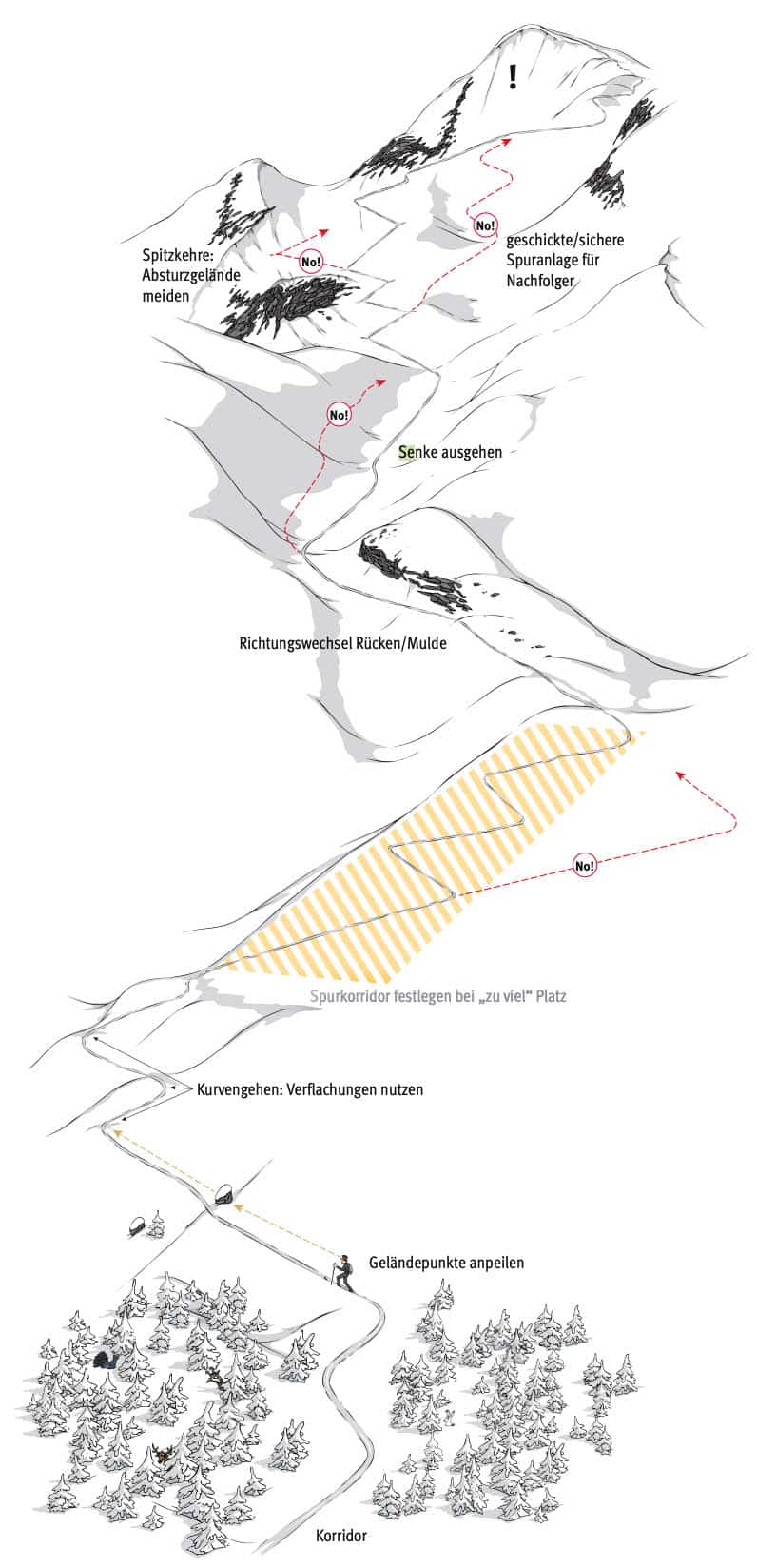
Steilheit ist relativ. Eine zu steile Spur bleibt anstrengend, auch wenn sie gleichmässig verläuft. Noch ungünstiger ist ein Wechsel zwischen flachen und steilen Passagen – das stört den Rhythmus und kostet Energie.

Ein guter Richtwert für die richtige Steigung sind die Beine: Wenn du bei jedem Schritt stark aus den Oberschenkeln drücken musst und die Waden konstant unter Spannung stehen, ist die Spur zu steil. Selbst eine hohe Steighilfe bringt dann kaum Erleichterung.

Ist die Spur moderat angelegt, läuft es sich flüssiger. Ein gleichmässiger Rhythmus stellt sich leichter ein – entscheidend für Ausdauer und Effizienz auf längeren Aufstiegen.

Wähle Geländepunkte so, dass die Aufstiegslinie möglichst konstant bleibt. Wer steilere Abschnitte frühzeitig erkennt und anpasst, spart Kraft.

Hohe Steighilfen bieten nur bedingt Vorteile: Sie erschweren das Gleichgewicht, verkürzen die Schrittlänge und machen flache Abschnitte mühsam. Zudem verlagert sich der Druck auf den Vorderfuss, was das Vorrutschen begünstigt.

Auch der Spurabstand zählt: Eine leicht schmalere Spur als die Hüftbreite ist meist ideal – zu enge Spuren hingegen sind, wie wir Splitboarder wissen, einfach mühsam.

Spuranlage.

Für einen Tourenführer gibt es kaum eine bessere Visitenkarte als eine perfekt angelegte Spur, bei der Sicherheit und Genuss optimal berücksichtigt und das Gelände bestmöglich genutzt werden.

Wie sieht es rechtlich aus?

Touren zu führen, darf grundsätzlich jeder, solange es nicht kommerziell ist. Bei geführten Touren mit finanziellem Hintergrund gibt es klare Bestimmungen.
Touren, egal ob Sommer oder Winter, dürfen nicht von jedem kommerziell geführt werden, sondern nur von Personen, die eine entsprechende Ausbildung absolviert haben.

--> Bergführer
Der Bergführer oder die Bergführerin hat eine Fachausbildung gemäss Schweizer Bergführerverband (SBV) absolviert. Dies ist die höchste Qualifikation für die Führung von Skitouren, auch in schwierigem Gelände. Sie sind durch einen Ausweis und ein Abzeichen des internationalen Bergführerverbands (IFMGA) legitimiert.

--> Schneesportlehrer oder Skiführer
Schneesportlehrer:innen mit einer Risiko-Lizenzierung sind berechtig Skitouren zu führen mit einem Schwierigkeitsgrad von höchstens WS. bei Touren und S bei Variantenabfahrten.

--> J+S-Leiter / SAC-Leiter
Instruktoren für Skihochtouren dürfen Mitglieder alpiner Vereine auf Skihochtouren (Begehen von Gletschern und kurzen Gipfelanstiegen im Fels) führen. Die Ausbildung ist ausschlieslich Personen zugänglich, die in Vereinen, Schulen oder anderen Non-Profit-Organisationen ehrenamtlich arbeiten. Zum erwerbsmässigen Führen sind diese Personen nicht berechtigt.

--> Ski- und Snowboardlehre mit oder ohne Ausbildung
Dürfen nur Unterrichten oder Kurse durchführen im Verantwortungsbereichs von Betreibern von Skilift- und Seilbahnanlagen.

Risiko beim Touren?

Ski- und Splitboardtouren im freien Gelände erfolgen auf eigenes Risiko. Haftungsansprüche jeglicher Art gegenüber Radical sowie gegenüber den Autoren sind ausgeschlossen. Das Begehen von Routen erfordert gute Kondition, seriöse Vorbereitung und technische Kenntnisse im Bergsport. Für sicheren Bergsport empfiehlt Radical Sports eine Ausbildung unter fachkundiger Leitung oder geführte Touren.

Wildtiere im Winter?

Winterruhe - Das ist der wichtigste Faktor für Wildtiere im Winter. Unsere einheimischen Tierarten haben sich an die harten Wintertage angepasst. Fellwechsel, das Absenken der Körpertemperatur, die Anpassung an die Nahrungsknappheit und passives aufwärmen an der Sonne sind nur einige Überlebensstrategien. Störungen in dessen Lebensräume können schnell über Leben und Tod entscheiden. Respektiere daher deine Grenzen!

Mehr Infos unter: Schweizer Wildruhezonen.ch

Versichert beim Touren?

Die gewerbsmässig angebotenen Aktivitäten unterstehen einer Bewilligungspflicht. Anbieter handeln gewerbsmässig, wenn sie in der Schweiz mit bewilligungspflichtigen Aktivitäten ein Haupt- oder Nebeneinkommen erzielen. Mit dem Vollzug sind die Kantone betraut.

Der Führende gemäss RiskG muss eine Berufshaftpflichtversicherung haben, die mit 5 Millionen gedeckt ist. Wenn ein Unfall trotz sorgfältiger Planung und Sicherheitsmassnahmen passiert und Folgeschäden auftreten, sind sowohl die Gäste als auch der Führer abgesichert. Schwarzführer haben diese Versicherung nicht!

Probleme und Lösungen

Es kann immer etwas schiefgehen. Wichtig zu wissen was, warum und wie man es beheben kann. Es gibt natürlich Unterschiede zwischen Splitboarder und Skitourengeher.

Problem:

Das Gehen mit Splitboardmaterial funktioniert zuverlässig, ist aber schwerer im Gewicht als der Durchschnitt bei Skitourenausrüstung.

Lösung:

Es wird mehr Zeit benötigt und die Ausdauer wird gefordert. Material abzugeben, kann helfen. Leichtere Ausrüstung natürlich auch.

Problem:

Splitboardbindungen haben viele bewegliche Teile. Teile, die brechen oder abfallen können. Ein Verlust kann zu grossen Problemen führen.

Lösung:

Ersatzmaterial mitführen. Equipment vor der Tour kontrollieren. Alle Schrauben mit Loctite (spezieller Schraubenleim) versehen.

Problem:

Querungen und Flachstellen können von Skifahrern einfacher überwunden werden als bei Snowboardfahrern. Das Steckenbleiben bei Flachstellen ist kräftezehrend und mühsam.

Lösung:

Querungen und Flachstellen meiden, genug früh ankündigen und höher anfahren. Frühzeitig die Stöcke bereit stellen. Skifahrer dürfen helfen beim ziehen und Aufstehen. Es wird mehr Zeit benötigt und die Aussdauer wird gefordert.

Problem:

Das Anfahren bei viel Schnee an Flachstellen ist kaum möglich für Snowboarder. Das Gleiche auch beim Aufstehen.

Lösung:

Anhalten auf übersichtlichen Kuppen, sodass der Snowboarder leichter anfahren kann. Klare und frühzeitige Kommunikation, wo und wann der Besamungspunkt ist.

Eigenarten beim Tourengehen - Ski- und Splitboarder
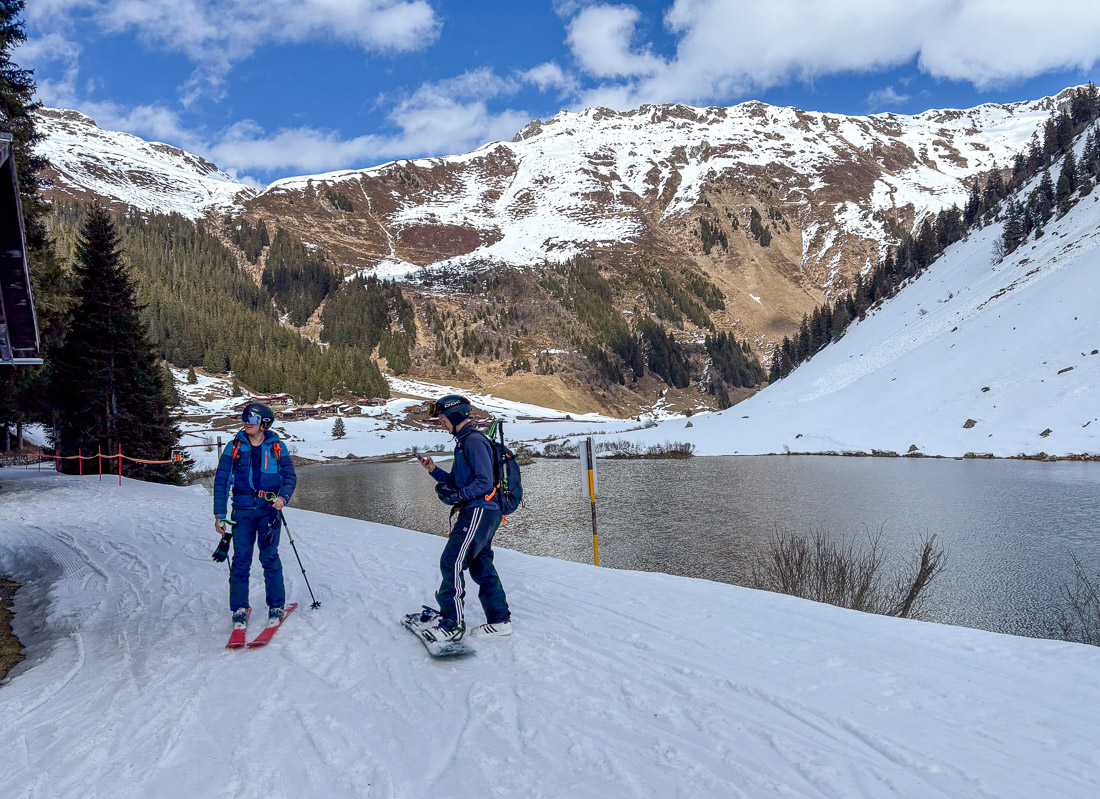
Flachstellen

Flachstellen

Flachstellen sind für alle mühsam. Für Snowboarder noch mehr. Da die Boarder eine seitliche und fixe Stellung haben, ist auch das Stossen mit Stöcken sehr anstrengend. Schon kleine Gegenanstiege kosten Kraft und Zeit. Bei Neuschnee oder Karstgebiet der grosse Hass. Je nach Passage, lohnt es sich sogar, wieder anzufellen, da ein Laufen mehr Kraft und Zeit benötigt. Mit dem Splitboard ist man also deutlich weniger flexibel und muss im Notfall oft erst umbauen.
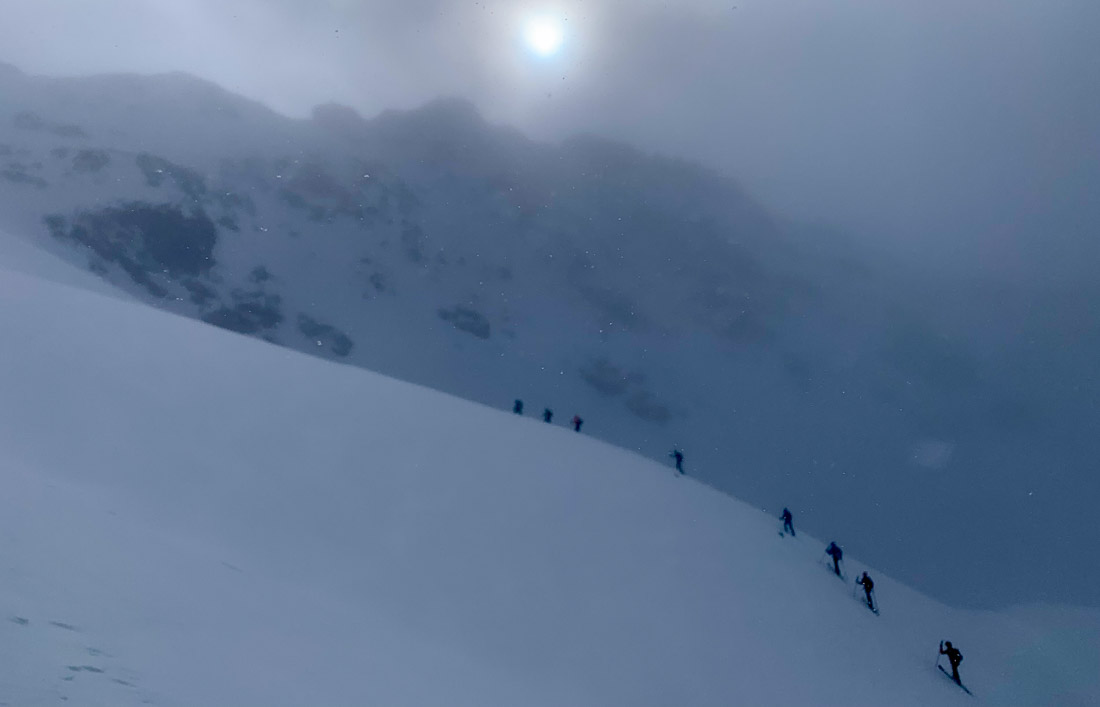
Traversen

Traversen

Lange Traversen kosten Kraft. Im Aufstieg, weil das Ski vom Splitboarder meist breiter ist und die seitliche Stabilität weniger ist als bei Skitourengeher.
In der Abfahrt je nach Fussstellung. Auf der Backside-Kante brennen schon nach kurzer Zeit die Waden. Bei Frontside die Schienbeinmuskulatur. Das Wechseln auf Rückwärtsfahren ist mehrheitlich keine Option.
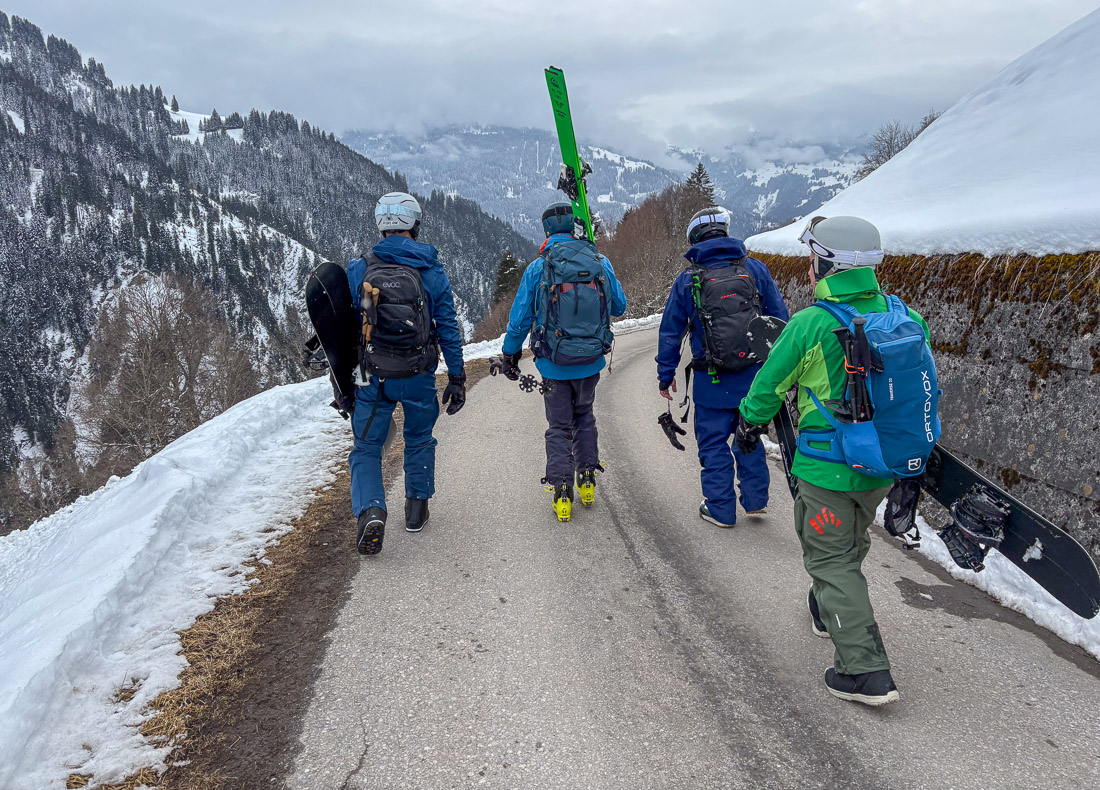
Laufpassagen

Laufpassagen

Das Gehen in Snowboardschuhen ist allgemein sehr angenehm. Die weiche Sohle und der weichere Schuh sind ideal, um auch mal längere Strecken auf Asphalt oder hartem Schnee zu gehen. Einer der grossen Vorteile bei den Snowboardboots. Bei Eis und Fels sind die Tourenschuhe schon besser geeignet, da sie eine härtere Sohle haben. Laufmodus einstellen nicht vergessen.
Auch muss man sich bewusst sein, dass man beim Splitboarden etwa 20 bis 30 Prozent mehr Kraft braucht, was die Dynamik in der Gruppe verändert.
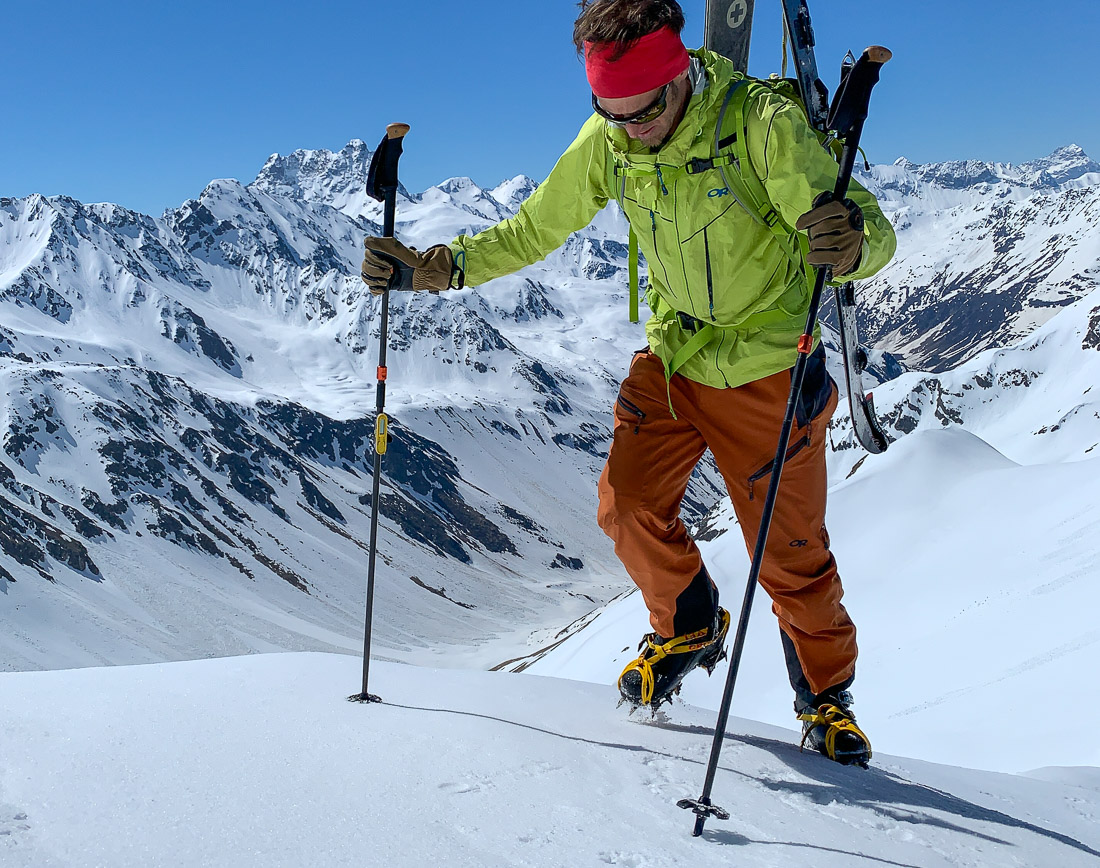
Steigeisen

Steigeisen

Neben den normalen Snowboardschuhen gibt es auch spezielle Splitboardschuhe. Die haben meist einen Gehmodus, weniger Vorlagenwinkel und eine Bergsohle wie bei den Bergschuhen. Manche sind auch steigeisentauglich. Bei Fels und Eis werden bald schon Steigeisen benötigt. Bei Tourenskischuhen halten Steigeisen super. Bei den normalen Snowboardschuhe leider nicht so. Auch wenn es spezielle Steigeisen für Snowboardboots gibt, wie die Grivel G10. Besser sind da schon Splitboardschuhe oder noch besser Hardboots Splitboardschuhe. Die sind dann auch wie Skitourenboots steigeisenfest.

--> Lese mehr über Hardboots Splitboarding
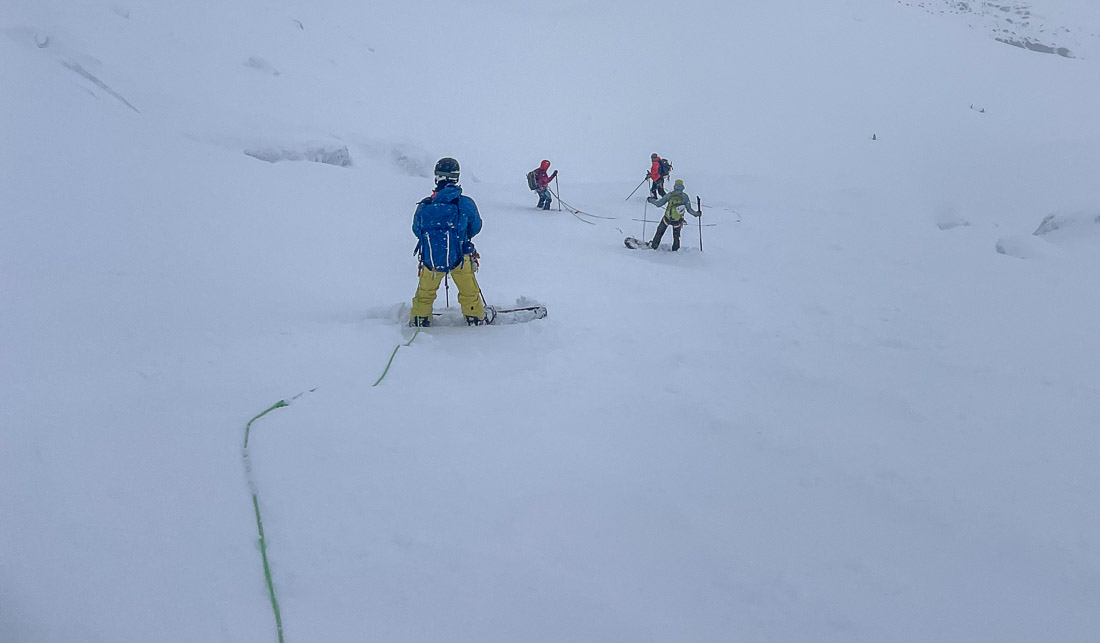
Fahren mit Seil

Fahren mit Seil

Anseilen wir üblicherweise am Gletscher aufgrund von Gletscherspalten und Abrutschgefahr. Im Aufstieg ist die Handhabung analog wie bei Skitourengehern. In der Abfahrt benötigt der Snowboarder etwas mehr Platz zum Wenden. Gutes Fahrtkönnen und klare Kommunikation sind da wichtig. Stöcke für das Gleichgewicht können helfen.

--> Lese mehr über Hochtour mit Splitboard
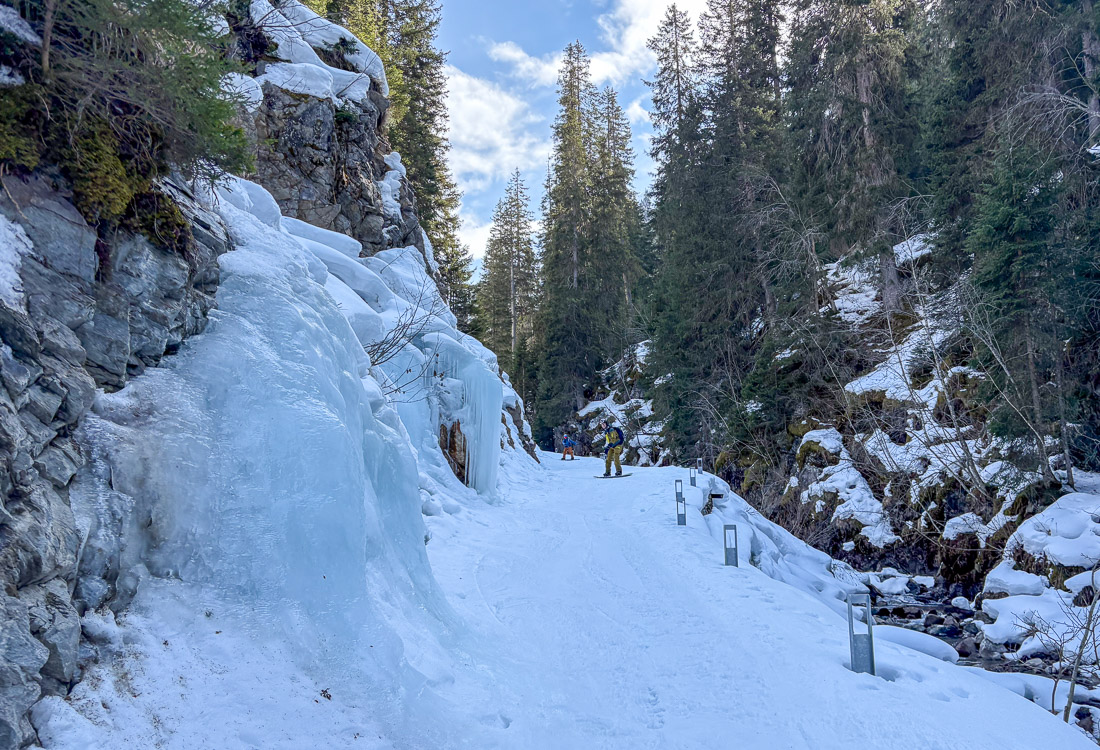
Eisig

Eisige und enge Passagen

Kein Boarder liebt Eis. Speziell wenn es schon durch das Rutschen von Skifahrern einen engen Kanal gebildet hat. Mit nur einer Kante ist das Navigieren anstrengend und schwierig. Immer wieder Pause einlegen und bei kritischen Stellen lieber zu Fuss gehen. Aber nicht auf die Idee kommen, auf das Brett zu sitzen und so runterzurutschen. Das kommt meist nie gut. Das Board rutscht weg und landet im Tal.

--> Lese mehr über geeignete Einsteigertouren
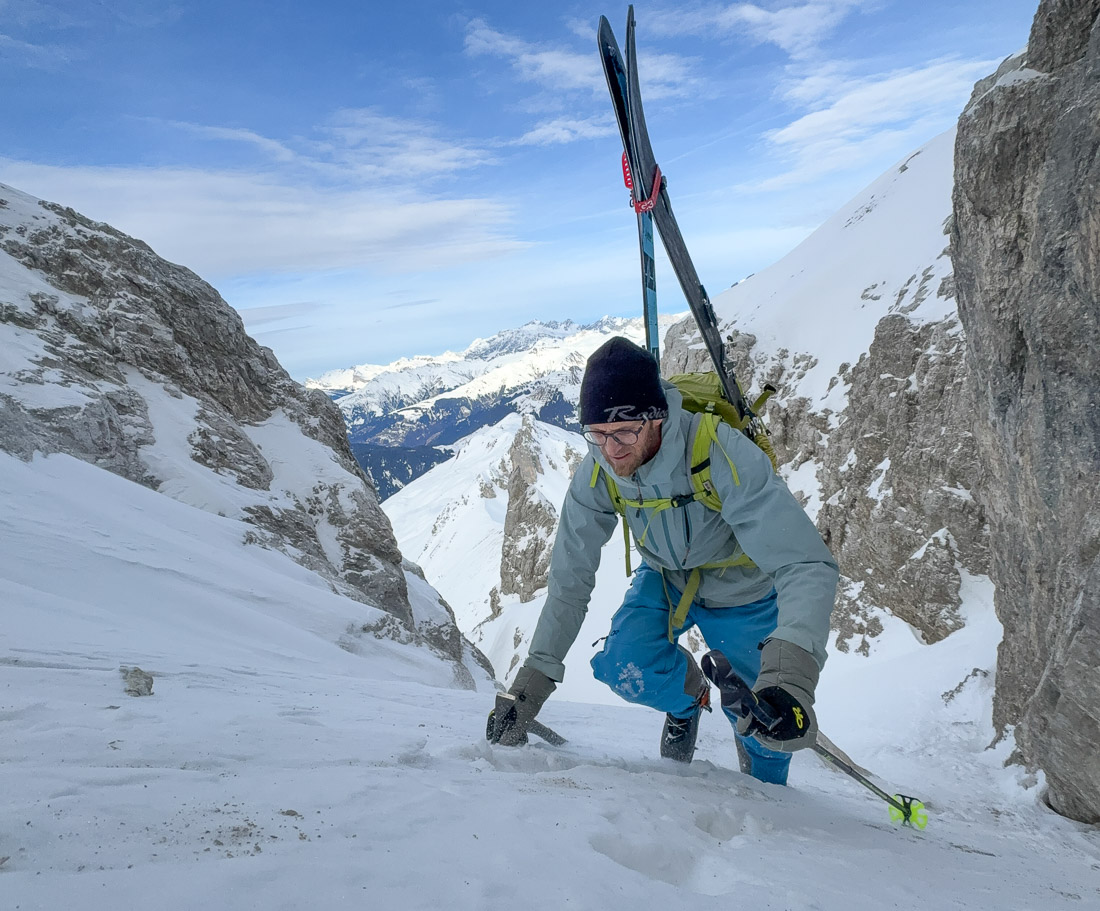
Anbinden

Befestigen vom Material

Für das Anbringen vom Splitboard, wird ein Rucksack benötigt, der die Breite vom geteilten Board anbietet. Nicht alle Rucksäcke sind für Splitboarder geeignet. Ein Oben-Zusammenbinden hilft, dass unten genug Platz ist zum Laufen und der Ski nicht verrutscht. Die Bindungen entweder mit befestigen, in den Rucksack legen oder abgeben. Denn die Splitboardbindung kann schnell mal vom Board fallen.

--> Lese mehr über Outdoor Material
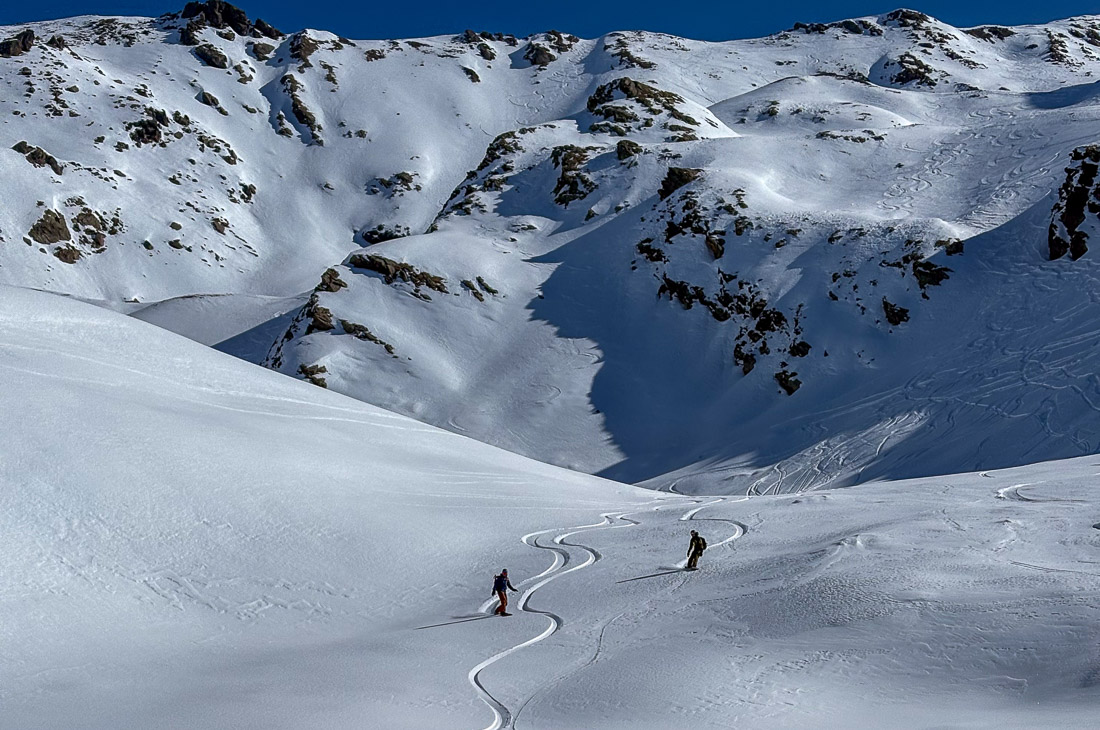
Pulverschnee

Schneearten

Alle lieben Pulverschnee. Am liebsten nur diese Art von Schnee bei Touren. Leider ist das nicht immer der Fall. Gute Snowboarder kommen auch mit Nassschnee oder Bruchharsch zurecht. Für Skifahrer eher der Hass. Der Shape vom Board ist dabei wichtig. Ein Fish-Shape mit langer Nose, funktioniert auch bei Bruchharst ziemlich gut.

--> Lese mehr über Tourengehen bei Schneearten

Links:

--> Die perfekte Tourplanung - Tipps von den Experten
--> Welchen Bindungswinkel soll ich wählen und warum?
--> Die besten Einsteigertouren für Splitboarder und Skitourengeher
--> Infomationen zur Tourenplanung

Wie findest du unser Angebot?
Gibt es Touren, Events, Kurse, die dich interessieren, wo fehlen? Gibt es Optimierungen, die dir aufgefallen sind? 
Wir freuen uns auf einen Kommentar von dir.
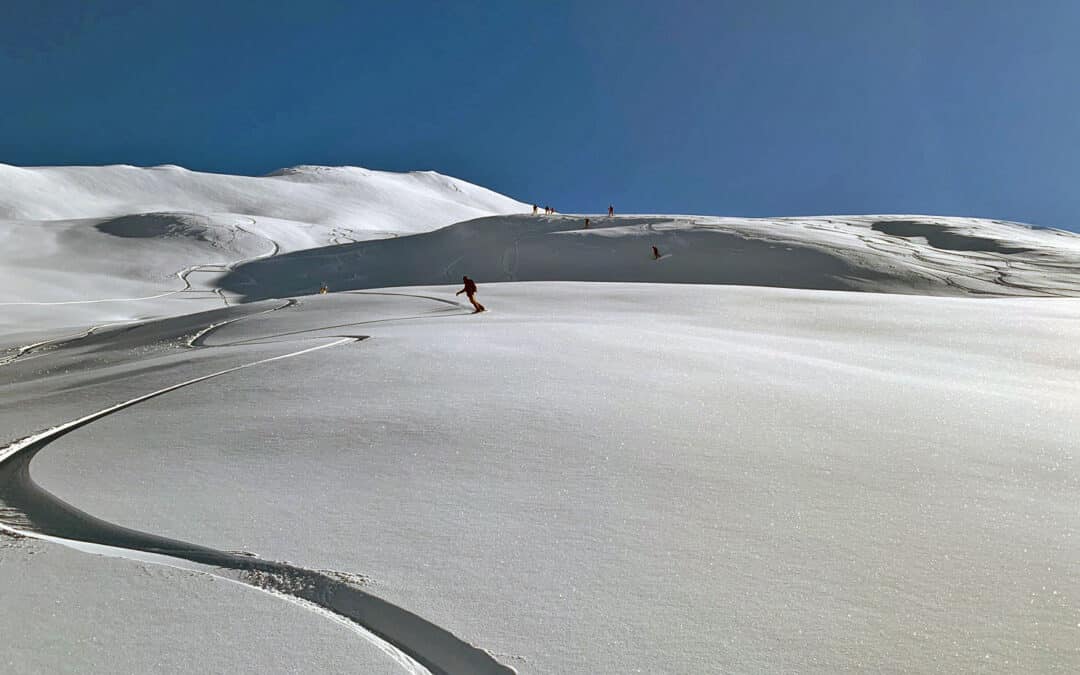
Planning the perfect tour | Tips from the experts

Planning the perfect tour | Tips from the experts

Allgemein @en, Freeride and Touring

Every year, we put our heads together and set off in search of the perfect tour for you: fresh powder snow, secluded landscapes, alpine ambience and much more. Find out how we plan our tours and what we pay attention to.

The idea of THE best ski or splitboard tour is of course subjective. The quality of a tour depends heavily on the individual experience, but above all on the constantly changing conditions. The real challenge lies in correctly assessing these conditions and making the best possible use of them for the tour. There are many different factors to consider. A successful ski tour therefore requires a combination of different "ingredients". As guides at Radical Sports, we specifically look for these factors when planning a tour, which we would like to discuss in more detail below.

Radical ski and snowboard tours

Safety is always our top priority, which primarily includes paying attention to the current avalanche risk. Despite the advances in avalanche research and our experience as guides, it remains important to show the necessary respect for this natural phenomenon and maintain a healthy level of caution. This is the only way to travel with an acceptable level of risk in the long term. The avalanche situation therefore defines the framework within which we can operate.

The next "ingredient" that we take into account during planning is a greater number of downhill meters than uphill meters. We achieve this, for example, by using public transport and cable cars or by descending to a lower valley. It is important that the descent is never neglected!

Of course, we always make sure that the tour is suitable for splitboarders. So no or hardly any flat spots or traverses.

All tours should also be suitable for public transport. Sustainable in terms of nature, but also sustainable in terms of positive memories.

Last but not least, the tour should take place in an impressive alpine landscape that leads us through various terrain chambers and regularly offers new terrain forms. This is precisely why we value crossings: Whenever possible, we climb the mountain from one side and descend it on another. In this way, we discover different sides of the mountain, provide a change of scenery and enjoy ascending in sunlight and descending in cool, shady powder snow.

Lidernen
img 2142
d226801
img 1672
d226813
Refresh Kurs
IMG 0814
Niki mit Splitboard
img 1686
dscn2371
img 6863
Feldis
img 6644
img 6233
img 1385
3D136671
img 20190303 093140
img 20180218 114723
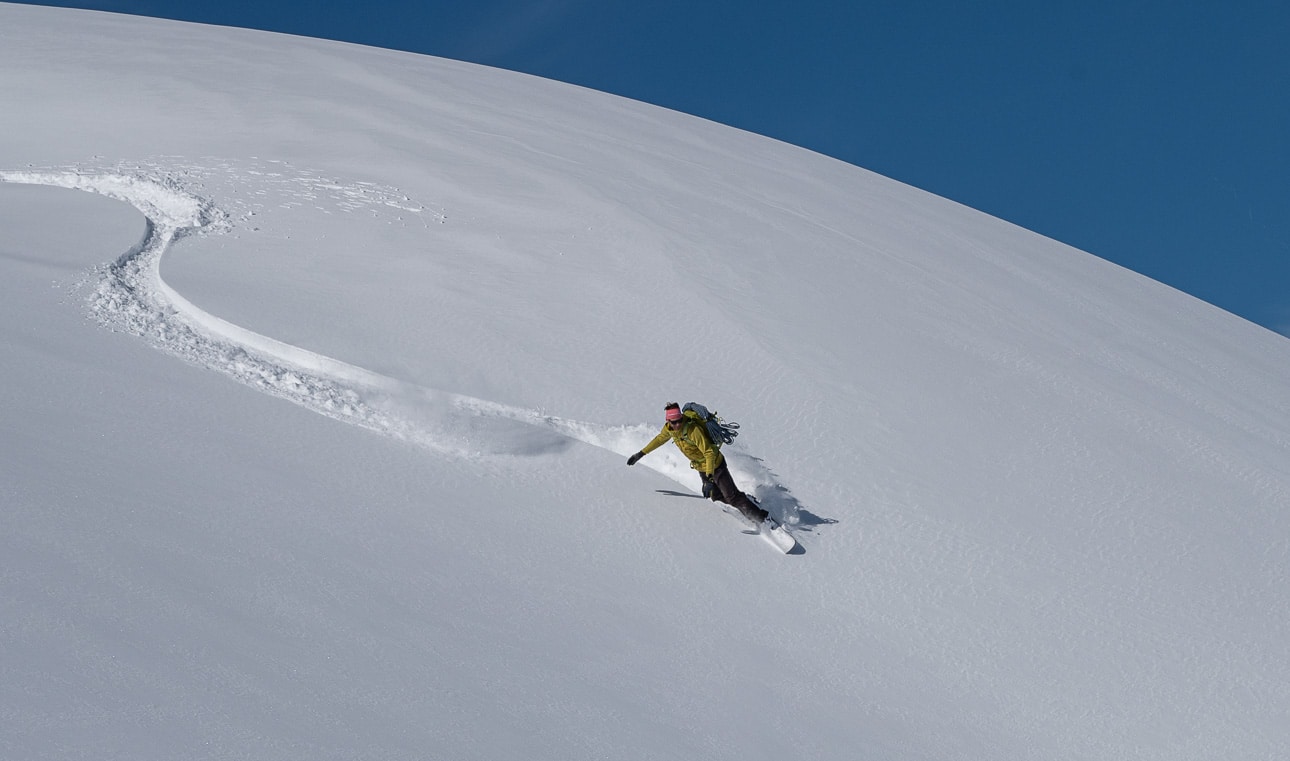
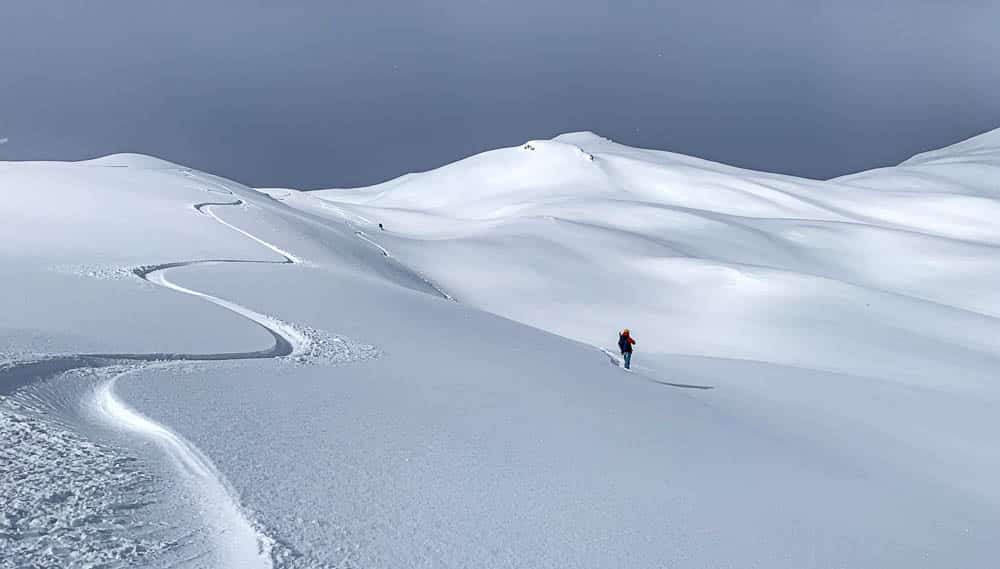
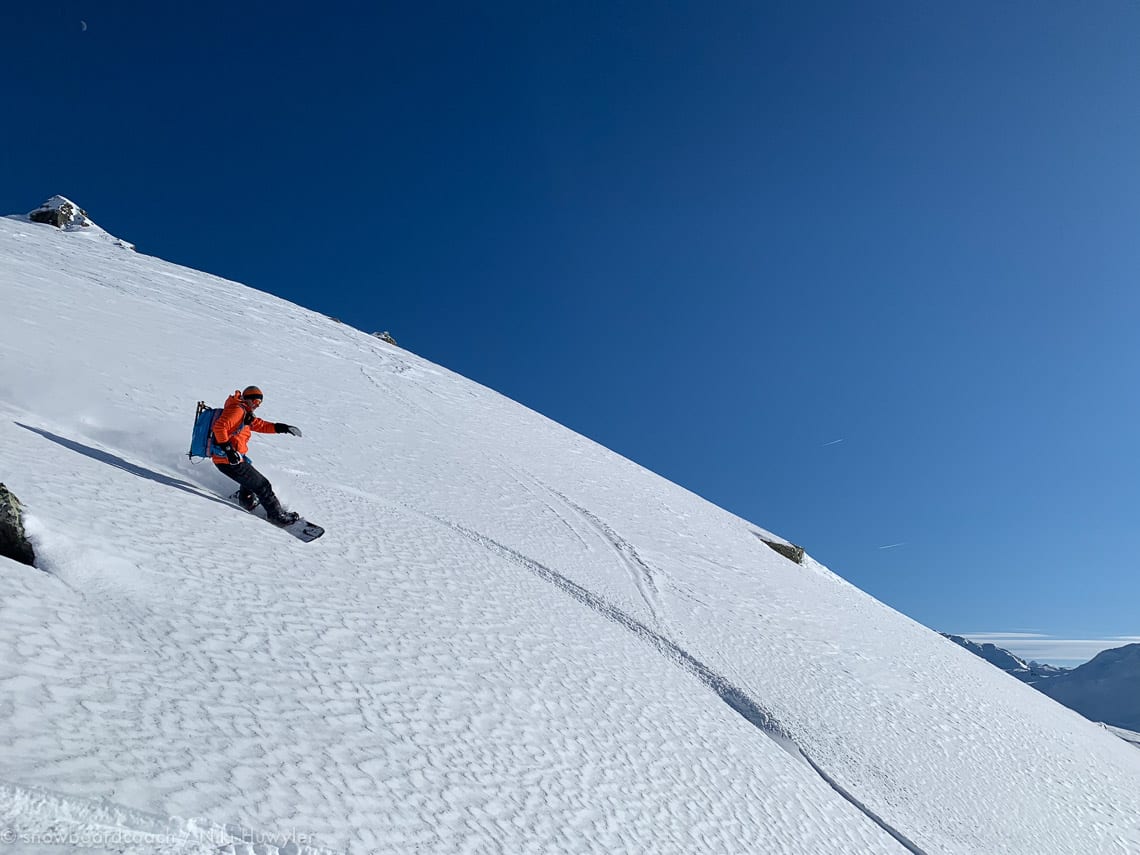
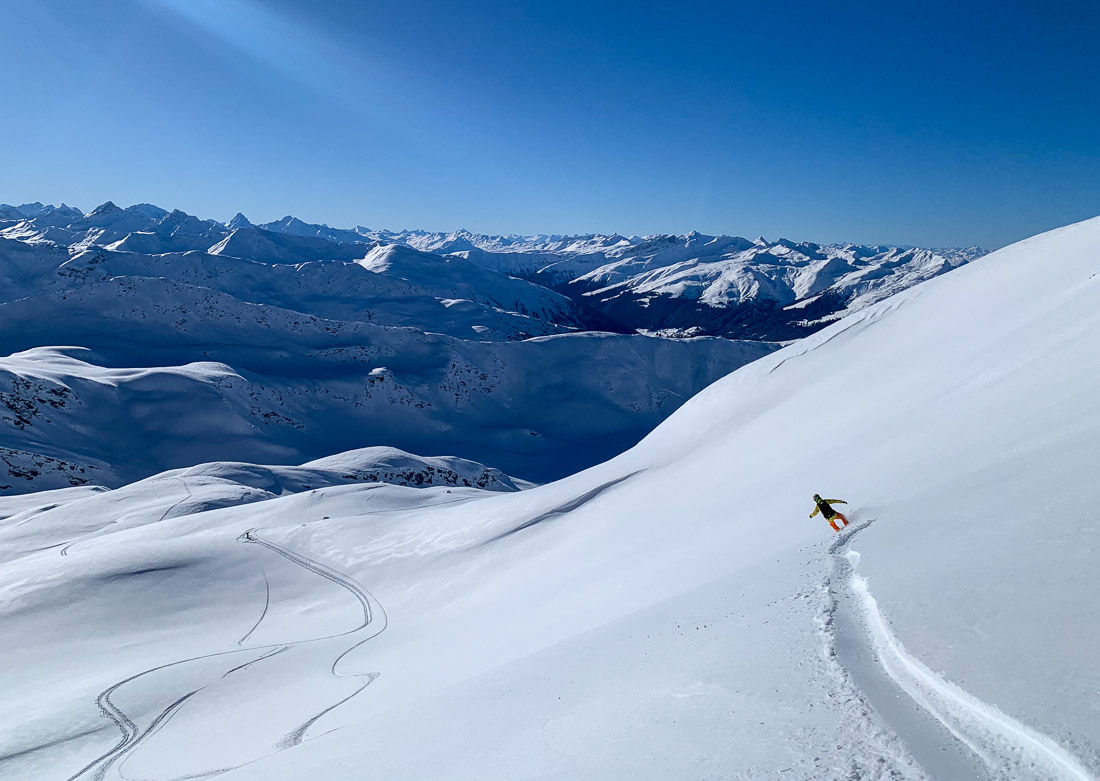
Abfahrt vom verschneiten schönen Zwölfihorn.
Lenzerheide-Arosa Freeride Rundtour
img 6242
img 1346

Book your dream tour with us

Subscribe to our tour mail and book this tour exactly when we offer it as a spontaneous tour in ideal conditions. Or alternatively ask for a private guide on your preferred date.

  • All
  • Guides
Dominique Betschart

Dominique Betschart

Michi Marti

Michi Marti

Moritz Heiser

Moritz Heiser

Tim Frey

Tim Frey

Sandra Heinz

Sandra Heinz

Andreas Rutz

Andreas Rutz

Niki Huwyler

Niki Huwyler

Private tour requests

Book this offer on your preferred date as a private tour.


    Wird Material benötigt?


    Unsere Datenschutzerklärung findest du Radical Datenschutz.
    Das Formular kann erst nach dieser Bestätigung verschickt werden.

    What makes our service so unique?

    We specialize in guided splitboard tours - by boarders for boarders. Of course, we also take ski tourers or, depending on the tour, snowshoers with us.

    The difference to other providers is that we are enthusiastic splitboarders ourselves. We know the demands and challenges of splitboarding and guide you through the Swiss mountains with expertise and a real understanding of snowboarders.

    Our tours are designed to protect nature and enjoy it responsibly. We use environmentally friendly practices and treat the mountains with respect. All our tours are public transport friendly.

    We don't do mass processing, but tailor-made adventures for every level. With careful planning and the knowledge of our experienced guides, we ensure a safe environment without sacrificing the real feeling of adventure.

    We deliberately keep our groups small so that we can focus on each individual. This not only creates a personal atmosphere, but also enables an intensive experience and promotes safety in the group.

    Simply knowing the tour is not a sign of quality. Our guides are trained snow sports instructors and have additional RiskG training. The knowledge required to carry out a tour in terms of risks, time planning. The human factor, conditions and knowledge of the area are a matter of course. But even in the event of a problem or emergency, our guides know what to do safely and reliably.

    What do you think about our offer?
    Are there any tours, events or courses that interest you that we can offer? Are there any optimizations that you have noticed? What are good tours for you and how do you go about it?
    We look forward to a comment from you.

    FAQ for our snowboard and ski tour offers

    What requirements do I have to fulfill to participate?

    You should enjoy learning and have the motivation to keep at it. To give you an overview of the requirements for our tours, we have created the following website: Requirements for our tours.

    You should pay attention to the following before registering:

    • Make sure that you meet the requirements for the tour. Check your physical fitness, your touring experience and, if necessary, your knowledge of the equipment to ensure that you are up to the demands of the tour.
    • Check whether you have the necessary equipment for the tour. If you are missing something, you can rent the missing equipment from Radical.
    What happens if a tour or course cannot take place?

    Radical Sports AG reserves the right to cancel a tour:

    a) If the minimum number of participants is not reached. In this case, any amounts already paid will be refunded in full.
    b) If the conditions in the tour area are inadequate and no suitable replacement can be found. In this case, an alternative date for the tour will be offered first. If this does not suit the participant, he/she will receive a voucher for another tour of his/her choice. If this is also not acceptable, any amounts already paid will be refunded in full.

    What if I have to cancel a tour?

    If you do not take part in the course, we reserve the right to invoice you or retain the tour already paid for as a no-show fee. Cancellations are only possible free of charge, unless otherwise stated, up to 48 hours before the tour at the latest. After that, a fee of CHF 100 will be charged.

    In the event of a no-show or cancellation on the same day, regardless of the reason, 100% of the course fee is due. This also applies to tour equipment that you have rented from us.

    What about liability and insurance?

    Participation in a tour is at your own risk. Participants must ensure that they have sufficient insurance cover themselves, in particular for accidents and rescue. The organizer accepts no liability for damage caused by inadequate insurance cover. Existing illnesses or medication that are relevant to safety should be reported to the responsible guide in good time before the tour.

    Do I have to provide my own food on a tour?

    Yes, we usually eat from our rucksack. Dried fruit, energy bars, dried meat, cheese, wholemeal bread and chocolate are all good options. Make sure your rucksack doesn't get too heavy, so you shouldn't pack too much food. Instead, it is important to take enough to drink with you. Thermos flasks with a volume of 0.75 to 1 liter are ideal.

    I have little experience with the avalanche transceiver. What should I do?

    No problem! No previous experience with avalanche transceivers is necessary for our beginner tours. Nevertheless, we recommend that all participants, even advanced ones, practise using the avalanche transceiver regularly. Our avalanche transceiver training courses are ideal for refreshing or improving your skills.

    I have a tour in mind that I would like to do myself

    No problem. We can also help you with planning and recognizing the key points. Proper risk management is essential in mountain sports. We also offer courses on this, in groups or privately. You may also find my tips under: www.snowboardcoach.ch/tourenplanung/

    How well does a splitboard work in practice?

    Technically speaking, the splitboard has been around for a long time, but in recent years it has been significantly improved and is now extremely robust.

    It works brilliantly and allows you to reach almost any summit. Switching from uphill to downhill mode is quick and easy, so you can enjoy that incomparable snowboard feeling on the descent.

    There are different binding systems for soft and hard boots that are optimally adapted to different preferences and conditions. It's best to try it out for yourself - preferably in combination with a touring course to experience the full potential of the splitboard.

    Are tours sustainable and economical?

    Our closeness to nature makes us attach great importance to environmental protection.

    Whenever possible, we use public transport for our tours. Our clothing and snowboards come from ecologically sustainable production, and we always take our waste back down to the valley. We do this not only out of respect for nature, but also in the interests of future generations.

    Is it also possible with snowshoes?

    Many tours are possible with snowshoes and the board on your back, but it is much more strenuous. For a normally trained tourer, around 800 meters of altitude can be easily achieved with snowshoes, while 1200 meters of altitude can be reached with a splitboard. It's best to try out a splitboard - it rides like a normal snowboard. If you have any questions, please contact us.

    Course in English?

    Yes, that's possible. Most guides and participants speak German or both German and English. There's always a willingness to help each other out and translate when needed.

    Accessible tours

    "Barrier-free" means that everyone can enter, navigate and use all areas of a barrier-free living space safely and independently, largely without the help of others.

    Our website is also barrier-free. We strive to make our tours as accessible as possible. However, barriers can also arise in the mind - we want to avoid these too.

    Out and about in the sun, snow and the great outdoors, accompanied by expert guides, promotes awareness of your own body and leaves traces that go far beyond the snow.

    What does a "good driving style" mean?

    Good board control is a prerequisite for off-piste touring. You should therefore know your board, which includes sliding and traversing, changing direction with basic turns, stopping and stopping, riding the lift. All of this in deep or wet snow, of course! You also need to be able to stand up independently on any slope and in any type of snow.

    Touring means being able to ride well even in poor conditions


    Why are accurate valuations important?

    Every tour requires an assessment of the difficulty and terrain. Anyone who decides on a tour relies on the description. We think so: With good planning and precise information about the difficulty, many tricky situations - especially in alpine terrain - can be avoided in advance. Because if you overestimate yourself or are poorly informed due to inaccurate information, you can put yourself and others in danger.

    What should I bear in mind when registering?

    Are you ready for an off-piste tour? Our tours are suitable for splitboarders, ski tourers and snowboarders with snowshoes. Most of them are for beginners.

    • Type: Beginner to advanced tour. Riding ability according to level 1 - 3 described on this page.
    • Price: 180.- per person. Maximum 7 participants.
    • Price scale:
      → 390.- for one person.
      → 200 per person for two participants
      → 180.- per person for three or more participants
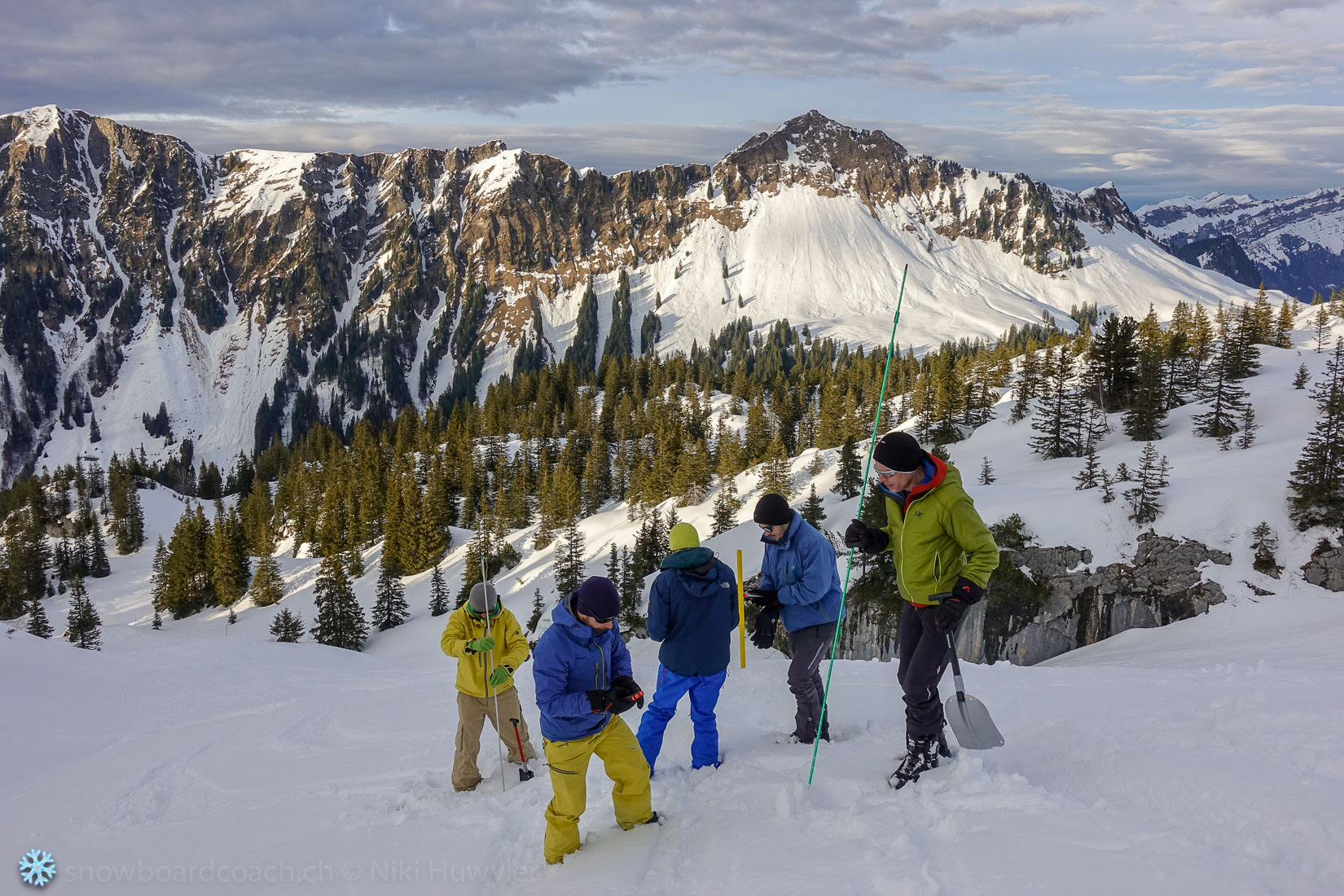
    • Equipment: You must bring an avalanche transceiver, probe and shovel. Touring equipment can be hired from us.
    • Additional costs: food & drinks during the tour day, possibly parking fees, possibly lift ticket
    • Payment information: Full payment at the start of the tour via cash or TWINT.
    • Detailed information: Follow 4-5 days before the start of the tour by e-mail
    Skills for beginners

    Your skills

    • Knowledge of the risk level
    • Knowledge of the avalanche situation report
    • Orientation knowledge
    • Card reading - Where am I!

    Your standard measures

    • Stay below 30° slope
    • Traveling in small groups
    • Careful route planning

    Recommendation for beginners:

    Moderately steep terrain under 30° slope inclination with generally safe and mostly favorable conditions. (Mainly level 1+2 in the LLB)

    Skills for advanced users

    Your skills

    • Knowledge of the risk level
    • Knowledge of the avalanche situation report
    • Orientation knowledge
    • Card reading - Where am I!
    • Recognizing terrain traps
    • Knowledge of typical avalanche situations
    • Safe ski/snowboard technique

    Your standard measures

    • Careful route planning
    • Traveling in small groups
    • Adapted response from the LLB
    • Distances and individual access

    Recommendation for advanced users:

    Moderately steep terrain under 30° slope inclination with partially unfavorable and generally unfavorable conditions. (Mainly level 1+2 in the LLB)

    What is what about risks?

    Hazard = avalanche, fire, terrorist attack, lightning
    Exposure = proximity, a risk only exists if a hazard and the exposure occur together.
    Risk = probability of occurrence, severity of damage
    Risk = conscious decision, action, ethnic

    Risk is therefore always part of a venture. There is no venture without risks. However, risks are not necessarily associated with a venture. Rather, such a risk also requires a personal decision to act.

    Is touring dangerous?

    Mountain sports are dangerous and always involve risks. The danger of avalanches is just one of the many dangers. There are also frostbite, getting lost, falls, nausea and many more. Nevertheless, off-piste touring is wonderful and absolutely justifiable with professional risk management.

    Safety is our top priority. On our tours, we always pay attention to the participants and their ability, as well as the conditions and choice of route. Tour planning is the key to successful and safe touring. Various considerations, measures and activities are constantly required on ski-snowboard tours. Your help is desired and required.

    Risk management and route planning

    Tour planning is the key to successful and safe mountaineering and touring. It saves us from many dangerous situations and hardships. It is worth investing enough time in it. Planning should be fun and an integral part of the tour.

    One of the aims of the tour preparation is to obtain one of the following judgments:
    The idea of risk management is to identify, structure and quantify partial risks and estimate the overall risk - which, of course, can never be reduced to zero. The aim is to consciously deal with the greatest risks. Various considerations, measures and activities are constantly required to achieve this on ski-snowboard tours.

    Risk reduction method GKMR
    In recent years, the assessment of avalanche danger has often been defined by the steepness of the slope. Statistics show that this is not tenable. New approaches are needed. Algorithm-based methods such as the graphical reduction method have problems. The GKMR is an improved method.
    1. recognize dangers = What is the probability of an avalanche being triggered?
    2. assess the consequences = how drastic are the consequences?
    3. consider measures = What measures can reduce the probability of occurrence or mitigate the consequences?
    4. assess risk = how do I finally assess the risk taking into account the risk level of my group
    Put simply, risk = danger x consequence.

    The avalanche report is still the first step in any planning. But more important than the warning level is the information about the avalanche problem.

    Rough, - Detailed planning - Tour evaluation
    • Check avalanche and weather conditions
    • Assess terrain
    • Assess group members
    • Interpretation of the avalanche report
    • The right/necessary equipment
    • Evaluation of the tour

    Apart from the board/skis, bindings and boots, everything is protective equipment and therefore not sports equipment in the true sense of the word. Everyone has an avalanche transceiver, probe and shovel with them to help in an emergency. Further useful items can be found in the packing list.

    Would like to learn more about the avalanche transceiver - The measures

    Then we look forward to your participation in an LVS training course, and have a look at my open very detailed document about avalanche transceiver

    Where can I find good tours?

    The SAC has various guides in book form. There are countless websites on the internet, but beware. The tour descriptions can be very individual.
    For all mountaineers:
    Hikr.org . AIn general:connect.garmin.com or Strava. For mountain and ski tours also: gipfelbuch.ch Super also: skitourenguru.ch. Tour reports about the Fluebrig The Fluebrig Snow tours around the Ybrig Tours in the Sihltal and Ybrig.

    Also ideal on Niki's blog under: Beginner tours

    What is suitable for beginners?

    For beginners, we offer special guided beginner tours that are ideal for getting started. Here you will be introduced to the subject step by step. All tour dates and further information can be found on our website under Tour offer.

    What does a course/tour cost?

    This varies from course to course and training. Take a look at our offer on this page or contact us with any questions <a title="Contact us
    " href="https://radical.swiss/kontakt/" role="link">us. Depending on the course/tour, a mountain guide may be necessary if you are going over glaciers or climbing sections. The surcharge would then be added. Payment via TWINT, credit cards or bank transfer directly in our store with ticket system.

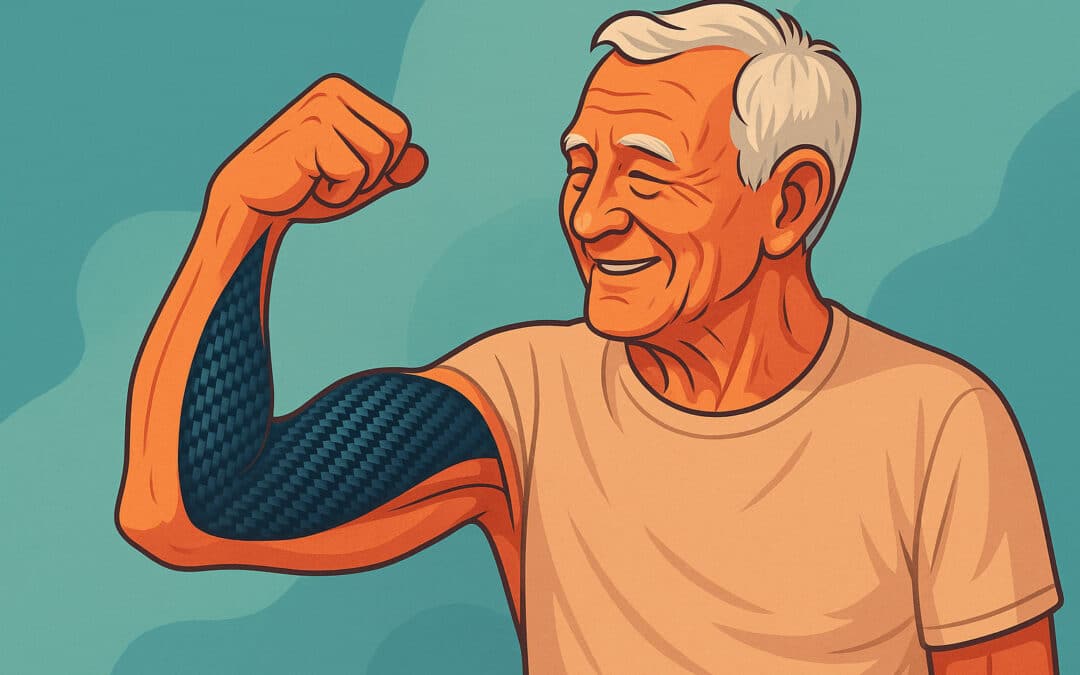
    Carbon: The material that (almost) doesn’t age

    Carbon: The material that (almost) doesn’t age

    Allgemein @en, Company, Ski, Snowboard

    Anyone who has ever been on a carbon ski or snowboard knows that the material not only feels fast - it is also impressively light, stiff and direct. But what many people don't know: Carbon hardly ages at all. No corrosion, no classic material fatigue. But how can that be?


    A high-tech material with inner values

    Carbon - or more precisely: carbon fiber reinforced plastic (CFRP) - consists of ultra-fine carbon fibers embedded in a plastic matrix. The fibers themselves are highly tensile - stronger than steel, but at a fraction of the weight. This structure is what makes the material so exceptional.

    The carbon atoms in the fibers are linked in extremely stable chains. This makes carbon not only chemically inert, but also extremely resistant to UV radiation, moisture and temperature changes. It does not rust, there are no plasticizers that volatilize and it retains its shape for many years.


    Fatigue? Yes - but only under extreme conditions

    Carbon is known for its exceptional strength and rigidity with minimal weight. It can withstand enormous loads - over many years. Whether repeated bending stress, strong vibrations, permanent compressive and tensile forces or temperature fluctuations: As long as the load remains within the design limits, carbon shows no classic signs of fatigue, as is known from metals, for example.

    Only under extreme conditions can a gradual change in the microstructure occur over very long periods of time - for example when high cyclic loads act millions of times, in combination with punctual overstressing, strong UV radiation, moisture, heat or chemical influences. Such scenarios generally only occur in industrial applications, high-performance sports equipment or incorrectly designed components.

    In everyday life - even under sporting or intensive use - carbon remains dimensionally stable and resilient. The material does not simply fatigue over time.

    However, carbon is less forgiving when it comes to punctual, lateral impacts. A seemingly harmless scratch or knock may have already led to a crack on the inside. But even then, disaster is not inevitable: With modern diagnostic technology, such damage can be reliably detected and permanently repaired - with complete restoration of structural integrity.

    Repairing instead of throwing away

    A Carbon breakage is no longer a total loss. With the right technology, damaged carbon bicycles, water sports equipment and other items can be repaired professionally and stably. This saves resources, makes economic sense - and extends the service life of the product by many years.

    In our other blog post on the topic of A carbon crack is not a death sentence - your bike can be repaired, we show you what is important when it comes to carbon repairs - and why it is worthwhile in most cases.

    Why carbon also makes sense in winter sports

    We have been using carbon in the development of our skis and snowboards for many years - and for good reason.

    Carbon is not a fashion trend, but a high-tech material with unique properties. It is extremely light, stiff and durable like no other material. Carbon really comes into its own in winter sports, where every gram counts and every movement needs to be precise.

    We use carbon layers in our boards and skis where they bring the most benefit: for more pop, more edge grip and a more direct feel. We do not rely on individual carbon strips or selective inserts, but on full-surface layers across the entire length and width of the product. This allows the fiber to act continuously - from tip to tail. This not only ensures maximum stability, but above all a harmonious distribution of power and a clean, precise ride.

    Another advantage: the return force - i.e. how quickly a ski or board returns to its original shape after a load - is particularly high with continuous carbon. This not only makes the turn more powerful, but also more controlled. The board remains reliable and responsive, especially in changing snow conditions or challenging terrain.

    Anyone who has ever been out on an ultra-light Radical ski or board knows how lively it feels. The reaction to steering impulses is more immediate, the edge grip more precise, the buoyancy in powder more playful. Carbon takes performance to a new level - and that is precisely why we use it uncompromisingly and with full expertise.

    Whether you're carving with pleasure, riding steep couloirs or on a splitboard tour - the reduced weight and optimized performance make all the difference. For us, one thing is clear: carbon doesn't just belong in Formula 1 or aircraft construction, but also on the mountain.

    That's why we have been using this material for decades - and are constantly developing it further in our skis and snowboards.

    Our conclusion: carbon is not a short-lived hype.

    Carbon is a modern composite material with enormous long-term stability - ideal for anyone who is looking for performance, lightness and durability. The material really comes into its own when it comes to skis and snowboards: Thanks to its unique structure, it can withstand thousands of times more deflection than conventional materials. This means: noticeably longer service life, consistent tension, no loss of performance - even after many seasons.

    But it's not just the durability that's impressive: carbon provides a more direct feel, more pop, faster edge changes and significantly more control. It makes the difference between good and great skiing fun - whether on a freshly groomed piste or in deep powder.

    We use it, we understand it - and we use it to build skis and snowboards that you'll never want to give up.

    Carbon is our DNA: Discover our latest models with carbon power - developed for maximum control, minimum weight and maximum riding fun. To our collection

    Or drop by our store in Zurich - and experience carbon the way it's meant to be.


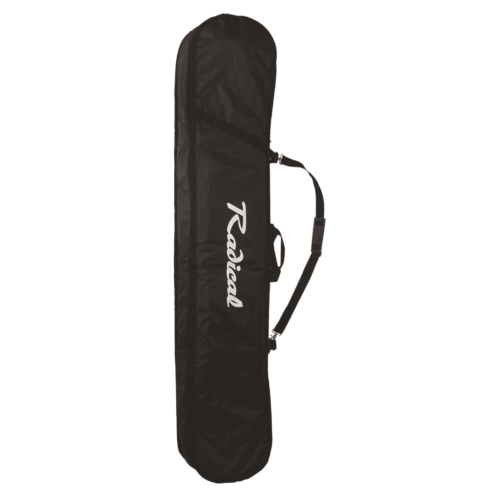
    • Boardbag

      Boardbag

      CHF 189 .-
    • Boardbag

      Boardbag

      CHF 189 .-
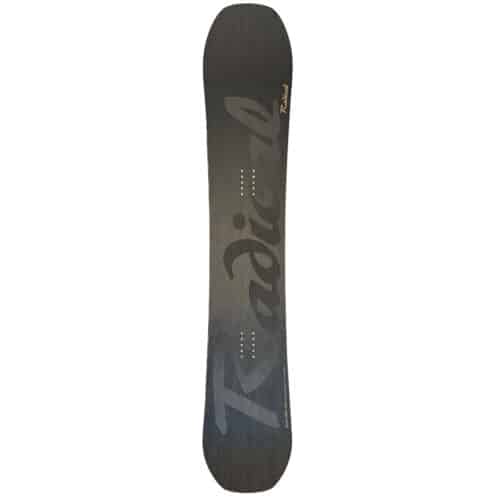
    • Das Radical Rider Snowboard mit seinem zeitlosen Design ist eines der besten Allround Snowboards der Welt.

      Rider 3.0

      Bewertet mit 5.00 von 5
      CHF 1'498 .-
    • Das Radical Rider Snowboard mit seinem zeitlosen Design ist eines der besten Allround Snowboards der Welt.

      Rider 3.0

      Bewertet mit 5.00 von 5
      CHF 1'498 .-
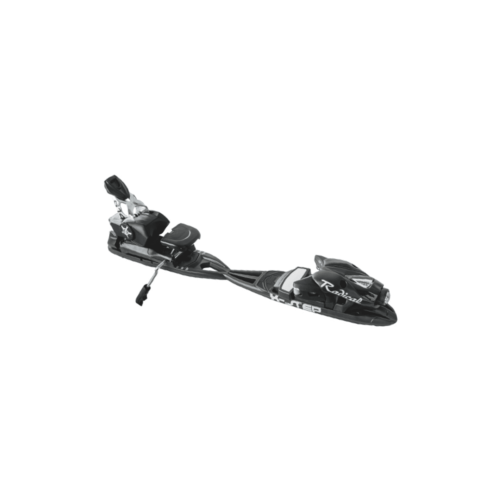
    • X-Step 412

      X-Step 412

      CHF 375 .-
    • X-Step 412

      X-Step 412

      CHF 375 .-
    • Gutschein

      Gutschein

      CHF 50 – CHF 500Preisspanne: CHF 50 bis CHF 500 .-
    • Voucher

      Voucher

      CHF 50 – CHF 500Preisspanne: CHF 50 bis CHF 500 .-
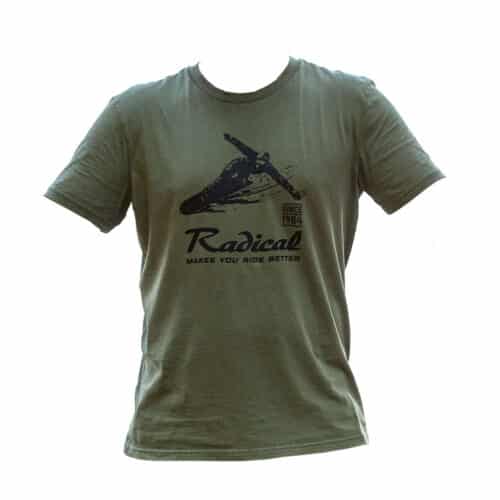
    • Radical T-Shirts

      T-Shirt

      CHF 45 .-
    • T-Shirt

      T-Shirt

      CHF 45 .-
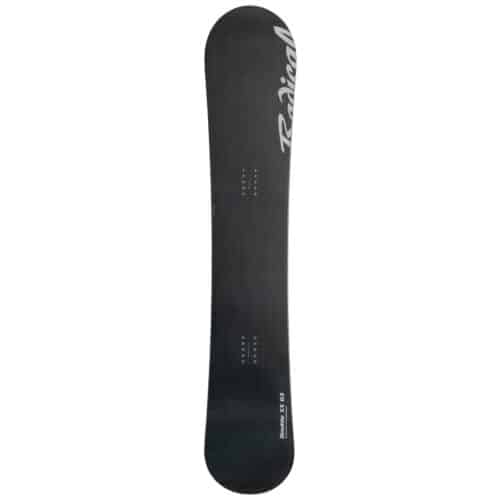
    • Angebot! Radical Double XX Snowboard. Eine Carving Maschine.

      Double XX

      Bewertet mit 5.00 von 5
      CHF 1'498 Ursprünglicher Preis war: CHF 1'498CHF 1'298Aktueller Preis ist: CHF 1'298. .-
    • Angebot! Radical Double XX Snowboard. Eine Carving Maschine.

      Double XX

      CHF 1'498 Ursprünglicher Preis war: CHF 1'498CHF 1'298Aktueller Preis ist: CHF 1'298. .-
    Radical Stories: In conversation with Roland Primus, founder of the oldest snowboard school in the world

    Radical Stories: In conversation with Roland Primus, founder of the oldest snowboard school in the world

    Allgemein @en, Company, Snowboard

    We are delighted to welcome Roland Primus, a formative pioneer of the snowboard scene, for an interview.

    As the founder of the world's oldest snowboard school and a pioneer of snowboard instructor training, he has had a decisive influence on the development of the sport. As a founding member of the SSBA and SSBS, he not only fought for the recognition of snowboarding as a winter sport, but also made a significant contribution to the professionalization of snowboard instruction in Switzerland. With tireless commitment and visionary ideas, he set new standards and created a foundation that still influences snow sports today.

    In an exclusive interview, Roland gives us exciting insights into the beginnings of snowboarding, his personal highlights and the development of the scene over the last few decades.

    Look forward to inspiring stories and anecdotes from the time when snowboarding was still a crazy adventure.

    The picture shows José Fernandes today. The snowboard pioneer par excellence.

    Picture: Roland Primus

    ... Every snowboarding career starts with a frontside and a backside turn and ends with it. Everything in between is nice, but not essential ...

    Please introduce yourself briefly.

    My name is Roland Primus and I am the founder of the oldest snowboard school in the world.

    As a founding member of the SSBA (Swiss Snowboard Association) and the SSBS (Schweizer Schneesport Berufs- und Schulverband), I not only helped to set up these associations, but have also dedicated my life to teaching snowboarding.

    Through my active career as a World Cup rider for Burton, I was able to gain valuable experience. In addition to my coaching training, I founded all the national snowboard teams in Switzerland. But it wasn't always easy to get there.

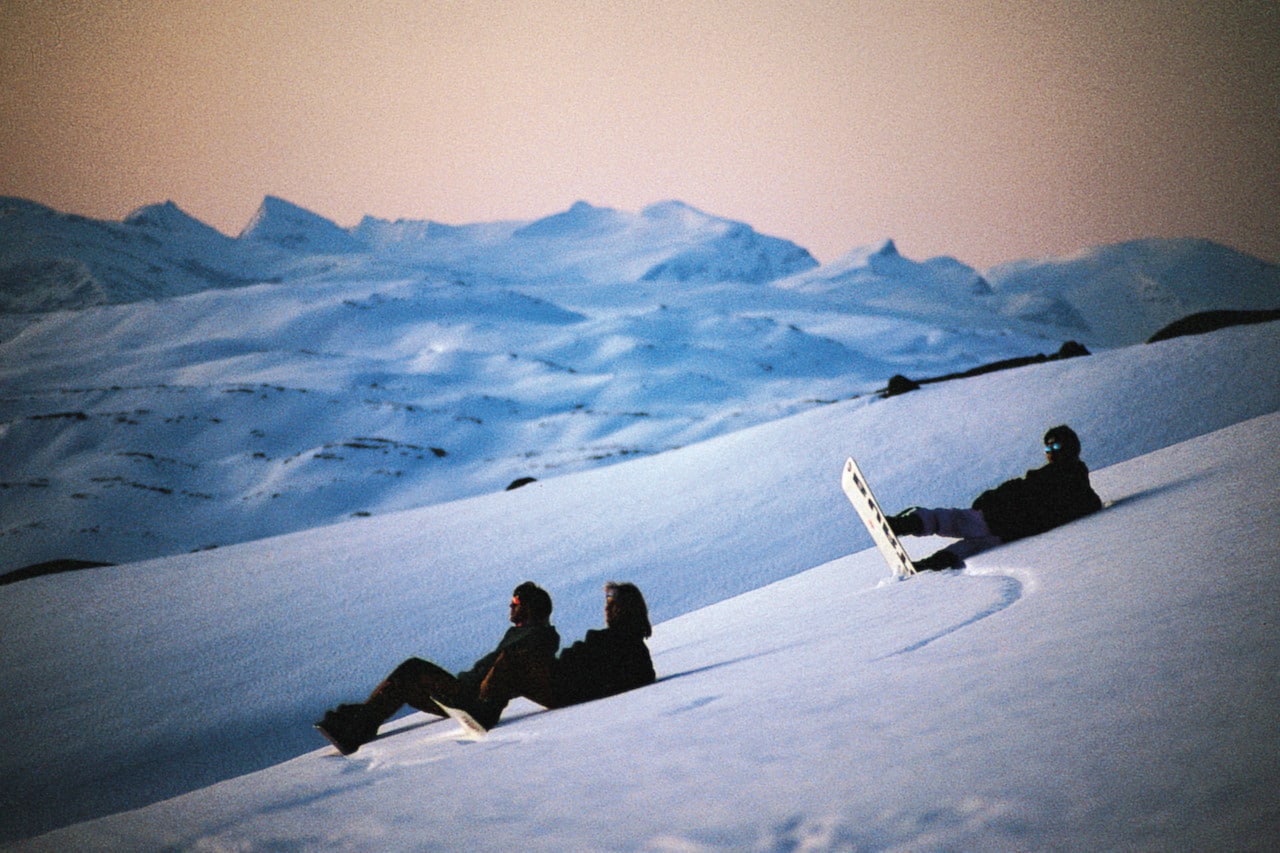
    3 Boarder mit Schatten
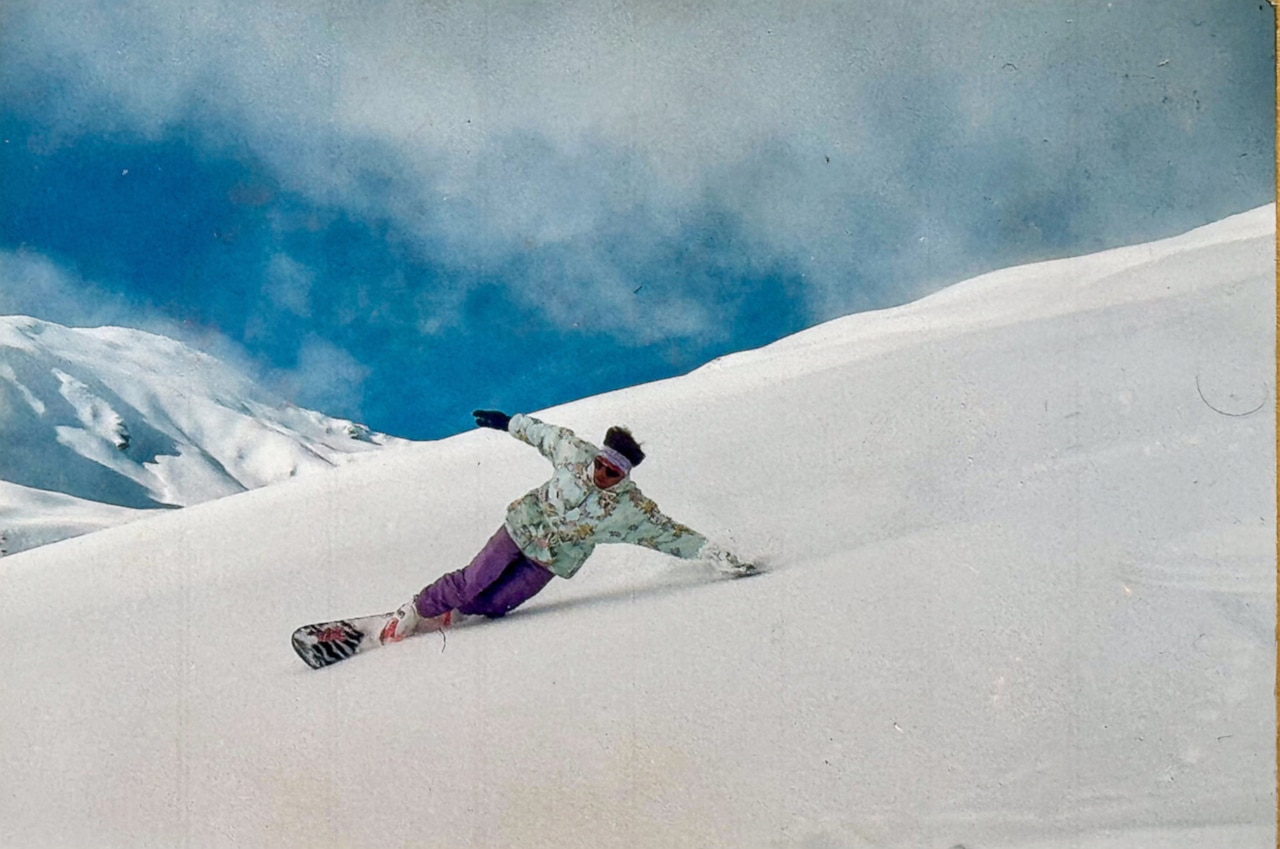
    Roland Primus Hardboot Powderturn

    Captions:

    1. Advance glacier near Flims-Laax, late 1980s
    2. Hardboot-Powderturn, unknown location, mid-1980s

    What was it like to open the world's first snowboard school?

    When I wanted to open a snowboard school in 1986, I found out that this was only possible with the consent of the local ski school. I felt this regulation was unfair. So I decided to take action against it - with far-reaching consequences. I took the responsible department and the canton of Graubünden to the Federal Court and won. This led to a revision of the law, a referendum and finally the adoption of the free market economy in the snow sports service sector. This meant that it was officially permitted to run snowboard schools independently of ski schools.
    From the point of view of the Swiss ski schools, this success probably made me the least popular snowboarder in Switzerland. But for me it was an important step for the future of snowboarding.

    This was followed by 30 years of fighting for the rights and opportunities of snowboarding in order to establish this sport as an integral part of winter sports. My goal was to offer everyone the best possible conditions to learn snowboarding - whether as a hobby, as an amateur or as a professional athlete.

    At the same time, I developed a method for the structural graphical representation of movements in a movement grid. I also wrote seven books on didactics and technique in snowboarding and skiing.


    Andy Tanner - First board, location Hoch Ybrig 1983

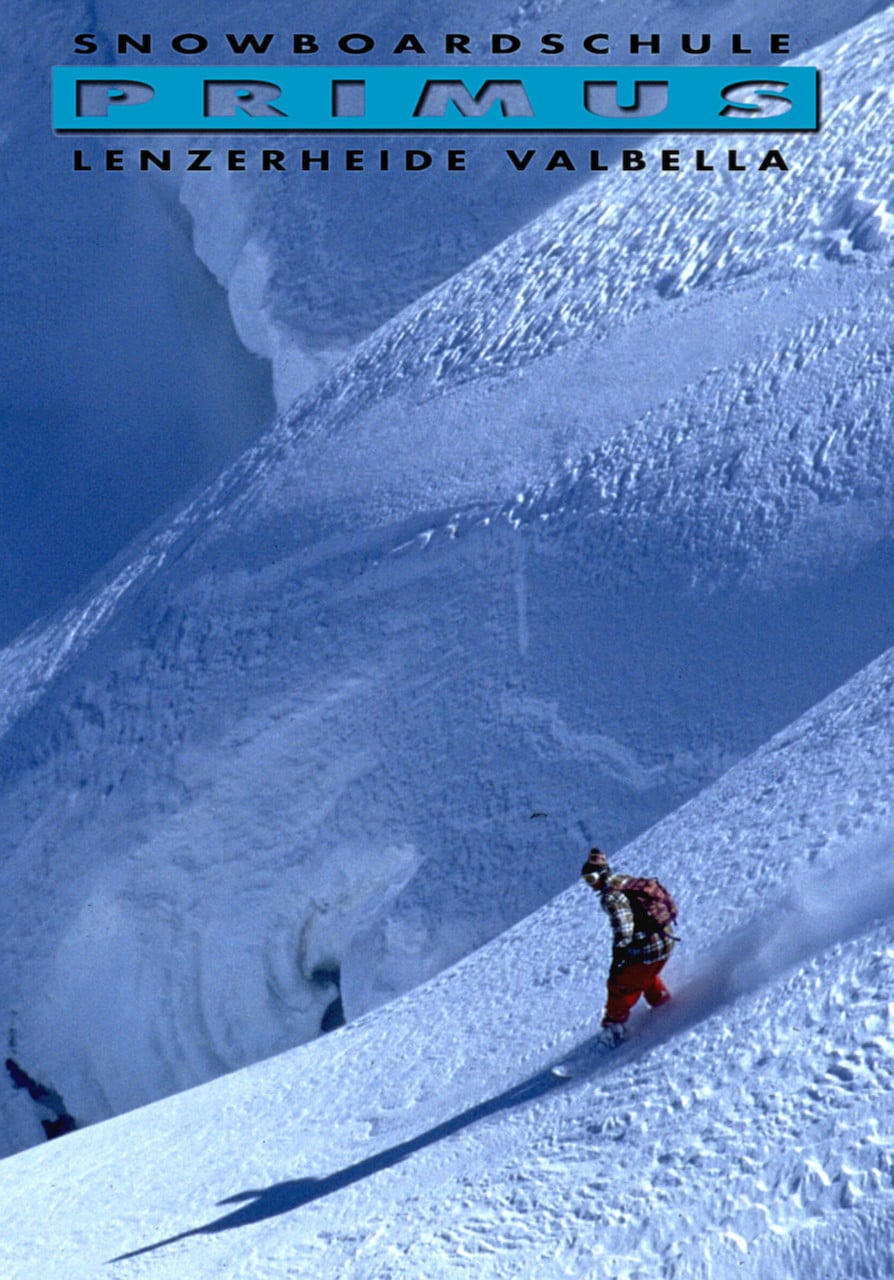
    Caption: Poster in front of the Primus Snowboard School in Lenzerheide - the world's first snowboard school. Taken on the Allalingletscher in the late 1980s.

    What excited you most about snowboarding back then?

    I was most inspired by the movement and dynamics of snowboarding. To this day, I consider it one of the most beautiful sports, as few sports combine dynamics and elegant movements like snowboarding. Keeping your feet fixed and the associated control over the sports equipment was a huge advantage over skiing. For us young people who lived in the mountains, "surfing" on snow brought a bit of a surfer lifestyle to our surroundings.

    Back then, it was extremely exciting to experience this new sport as a lifestyle in a rebellious group. The opposition from the ski lobby only brought us closer together, and the dynamic was not only overwhelming on the board, but also socially. You were part of something new, something different. The establishment was challenged and we were able to reinvent many things and define movements. Even the skiing world later adopted elements such as parallel slalom, boardercross, halfpipe and big mountain powder. It was incredible to be part of this development and to help shape it - it was a unique experience.

    What prompted you to found the SSBS?

    The main reason was - as is so often the case - dissatisfaction with something that already existed. The SSBA, the umbrella organization at the time, also took care of the competitions, which diverted financial resources away from training. That was unsatisfactory. That's why I founded the SSBS to be able to drive training forward independently. The national teams and coach training soon followed. While the SSBA took care of competitions and grassroots sport, the SSBS was dedicated to education and training.

    Once we had created the structures, we handed them back to the SSBA. Unfortunately, the association got into financial difficulties and was later taken over by Swiss Ski. My goal was to see Swiss snowboarding on the international podium - also as an advertisement for the schools.

    In my opinion, this was the best thing for the schools. If we as Swiss are top in international comparison, more people want to take part in sport, so it's better for the schools. For me, the race and the teams were a marketing tool for the schools. Without a lot of money, you could use the expertise of the schools and the training to get great publicity if you won titles. And that's what we did. Switzerland dominated snowboarding like no other nation during this time.

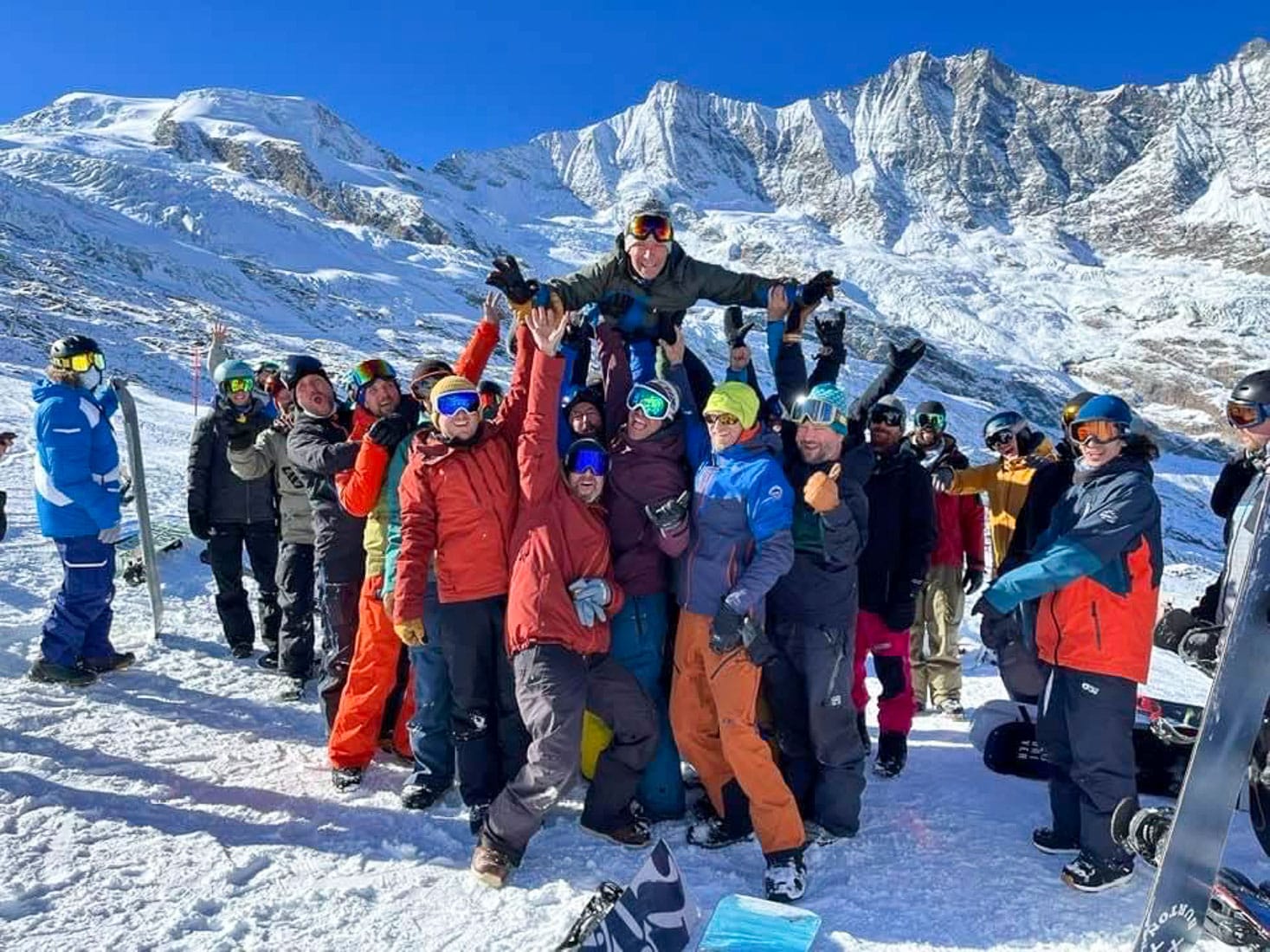
    SSBS feiert Roland Primus
    SSBS Vorstand

    Captions:

    1. farewell to Roland as Technical Director of the SSBS in Saas-Fee, November 2023.

    2 The SSBS Board would like to thank Roland for his many years of service. At the turn of the year 2024, he handed over his position as Technical Director to Lukas Sieber (to the left of Roland). The new SSBS President is Daniel Schmid (back right in the picture).

    What future do you see for the profession of snowboard instructor, and what role will it play in the further development of the sport?

    As in many areas, the right time to get involved is crucial. What was possible back then is often no longer possible today - and vice versa. That's why, from my experience, you can't deduce one-to-one what you should or shouldn't do today, as the framework conditions have changed.

    In the past, it was almost impossible to make a living solely by teaching snowboarding. Today, however, there are numerous opportunities to secure a permanent position in snowboarding as a coach or in organizations such as Swiss Snowboard, Swiss Olympic or Jugend+Sport. These structures did not exist in the past - they first had to grow.

    The structures for professional athletes are also better today than they were back then. But at the same time, the demands have also increased, while pay and sponsorship have not necessarily become more attractive. This is often the case when a sport is just starting out: there is a lot of potential and therefore also more financial resources.

    On the other hand, the snowboard industry is an area that has seen continuous stable development. Today, there are many opportunities to work in the sport - be it in development, production, marketing or sales. Anyone who wants to live the sport and earn a living from it has many options here.

    As a snowboard instructor, few have been and will be able to support a family on this alone. The seasonality makes it difficult, forcing many to find additional work or move between the northern and southern hemispheres to work all year round.

    Nevertheless, training to become a snowboard instructor offers the best foundation for understanding the sport in all its depth. It is the only way to really "study" snowboarding - to learn how it works, how to apply it and how to teach it. This knowledge is essential for anyone who wants to work in the industry.

    If you know how snowboarding works, you can be active in many areas:

    • as a trainer
    • as an employee of an association
    • in the competition area and in the organization
    • in industry, production or in sales and marketing

    This is why you can still find many former snowboard instructors in key positions within the sport today. They have the knowledge and experience needed to develop the sport further.

    Roland Primus Freeride
    Roland Primus Splitboard Camp
    Roland Primus Splitboardtour
    Roland Primus Fly and Split
    Roland Primus Spltiboarding

    Captions:

    1. powder skiing in Furcellas, Engadin, late 1990s
    2. Splitboard camp in Greenland, 2014
    3. Splitboard tour for a photo shoot for the Curli brand.
    Roland's latest project: dog harnesses. Together with Mark Zimmermann, he founded Curli to transfer their knowledge from mountain sports to the everyday lives of dogs and their owners. The result: high-performance dog harnesses that combine functionality, comfort and safety.
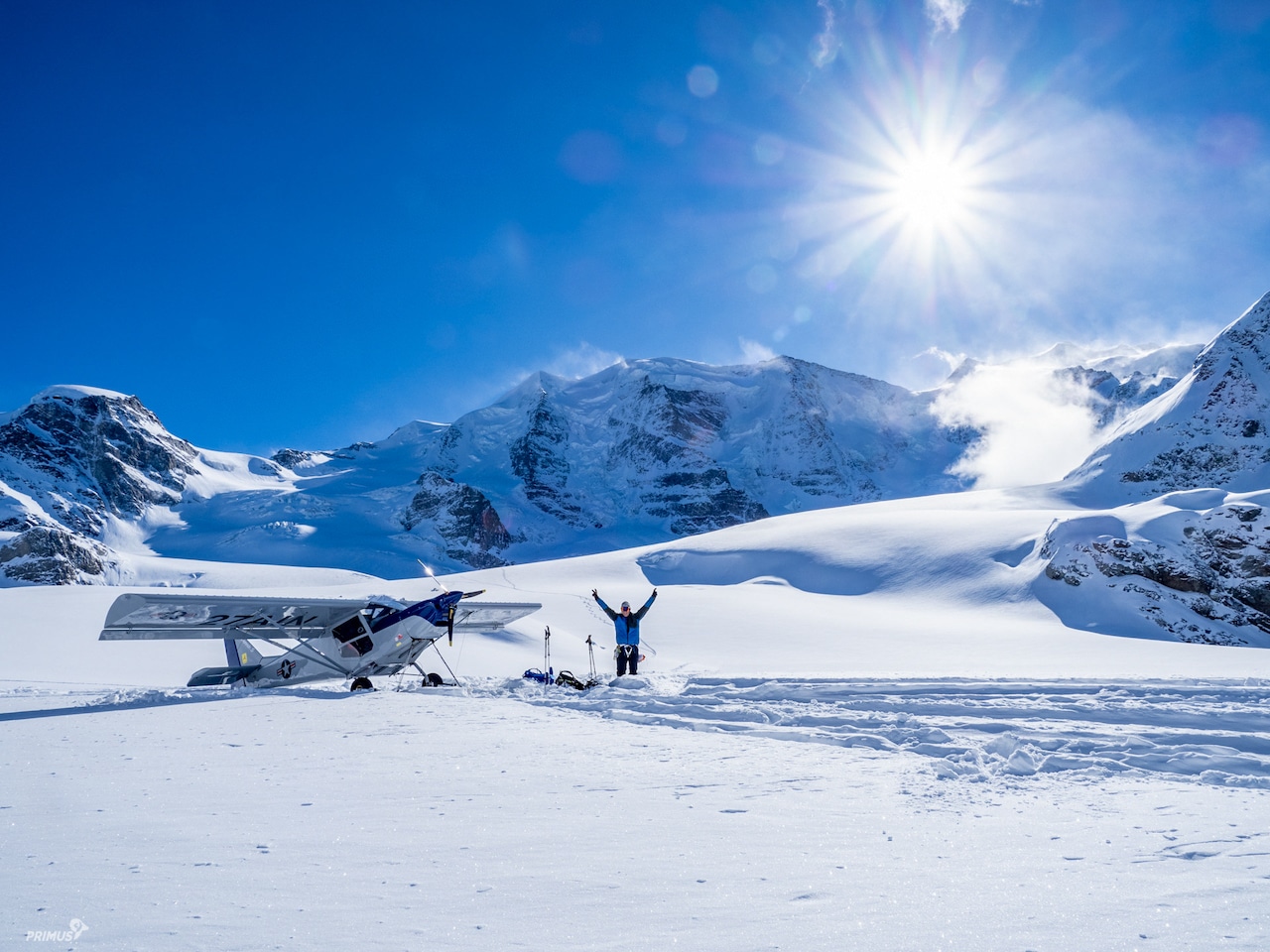
    4 Another passion: flying. Here in front of Piz Palü - Split & Fly might be a more appropriate name.
    5. Roland and his wife Claudia

    How did you experience the founding of Radical?

    Having ridden for Burton from the start, I paid less attention to Radical - but all the more to the man behind the brand: Mark Farner. For me, Radical = Mark Farner, because he understood the sport the way I did. But at the same time, he was also my competition rival.

    Mark had his own boards, which always gave him an advantage. That's why Radical was more of a problem than a solution for me back then. He was extremely fast on his board, even though he weighed significantly less than me - I must have had 25 kg more on my ribs. It was hard to beat him and for me it had to be the material.

    Luckily, Mark spent a lot of time in Zurich, where he built his "wonder weapons", while I trained in Laax and Lenzerheide and ran my two snowboard schools. The core construction of his boards was so elaborate and high quality that there was hardly another board that offered so much support. Radical was and is the board for dynamic riding with maximum grip.

    As is so often the case, the difference lies in the detail.

    ... "Looking back, I realized that there are three great loves in my life: My wife Claudia, snowboarding and flying"...

    How do you think Radical has influenced the sport?

    There was a time when all brands had to be measured against Radical when it came to performance. Radical was the measure of all things. With his brand, Mark Farner showed the entire industry what was possible in board construction and what riding characteristics a snowboard could have. In doing so, he gave the sport the chance to develop in the direction of more dynamics and speed.

    Snowboarding has not become so fast and dynamic by itself - Radical has made a decisive contribution to this. Thanks to Radical, surfing in powder, which worked perfectly with its infinite lateral positions and flowing carving in deep snow, could also be experienced on the piste. Grip was everything, and Radical made surfing on the piste possible. No other board could offer this in this form.

    In conclusion, one thing can be said with certainty: with Radical, Mark Farner has managed to bring the surf style of snowboarding to the slopes and at the same time lay the foundation for modern carving. Mark was a surfer - and one who sought and found carving on the "frozen wave".

    I thank him for that - and Radical.


    Are there any special moments or anecdotes with Mark Farner that you would like to share with us?

    One of the most impressive moments was when Mark presented his thesis. As a sports student at the time, he was writing his master's thesis on the biomechanical aspects of release forms in snowboarding. For me, this event is a milestone in the history of the sport.

    With his background in skating and snowboarding, he showed a completely new way - an understanding of movement sequences that was groundbreaking not only for snowboarding, but for many other sports. I think this is one of his greatest achievements - and also one of the most misunderstood.

    His findings were so phenomenal that hardly anyone understood them. It took the established ski sport decades to even understand them.

    For me as a competitor, Radical was often a problem, as already mentioned - but Mark Farner was the solution. But his true genius remained hidden from most people.

    Winter 83/84 in Churwalden
    Roland - Winter 83/84 in Churwalden
    Roland Primus
    Primus - Winter 83/84 in Churwalden

    Would you like to send us a message to celebrate Radical's 40th anniversary?

    Keep surfing. Every snowboarding career starts with a frontside and a backside turn and ends with it. Everything in between is nice, but not essential to becoming a snowboarder. Keep on carving your turns in the frozen wave.


    To conclude: At the end of the interview, after we had viewed and compiled the pictures, Roland shared a nice closing sentence with us:

    ... "Looking back, I realized that there are three great loves in my life: My wife Claudia, snowboarding and flying"...

    Thank you very much for the interview Roland!

    The picture shows José Fernandes today. The snowboard pioneer par excellence.

    Picture: Roland Primus - still a very successful businessman today.

    Radical Legends: Our story, told by those who shaped it

    To mark our 40th anniversary, we took a trip down memory lane and visited a few selected Radical legends from our eventful history.

    It is with great pleasure that we invite you to immerse yourself in history with us and relive the special moments. We will be publishing more exciting conversations until the end of winter - so stay tuned and be inspired!

    Have you been with us from the start or do you have a question? Share your thoughts with us - we look forward to your comment!

    Suitable tours for beginners

    Suitable tours for beginners

    Allgemein @en, Freeride and Touring


    Warning: Attempt to read property "D_parent" on null in /home/httpd/vhosts/radical-sports.com/dev.radical.swiss/wp-content/plugins/divi-event-calendar-module/D5/modules/EventDisplay/EventController.php on line 3617

    Warning: Attempt to read property "ID" on null in /home/httpd/vhosts/radical-sports.com/dev.radical.swiss/wp-content/plugins/divi-event-calendar-module/D5/modules/EventDisplay/EventController.php on line 3617

    The best beginner tours for splitboarders and ski tourers

    You should take it easy on your first splitboard tour. At Radical Sports, we'll tell you which tours in Switzerland are particularly suitable when there's enough snow.

    What are beginner/beginner tours and what are the requirements?

    Splitboard tours without steep and narrow sections are generally ideal for beginners. Whether a tour is suitable for beginners depends not only on the route, but also on the conditions. Even a medium-difficulty tour can be suitable for beginners in ideal conditions, whereas an actually easy route can be quite unpleasant in icy or slushy conditions, for example.

    Powder snow and blue skies, that would be the wish. Unfortunately, the reality is usually different. You rarely encounter powder snow from the summit to the end of the tour. The snow conditions are constantly changing. So do the demands on the snowboarder/skier. Powder, hard snow, wind-packed snow, slabs of ice, frozen avalanche cones - an experienced winter sports enthusiast can adapt to these conditions.

    You should still be safe and fearless on the board even in bad weather and when the black pistes are no longer perfectly groomed.

    It is difficult to give everyone a general answer as to what exactly you need to be able to do in order to be able to ski downhill in open terrain. However, there are a few things that you can easily practise in advance on or off the piste.

    You can find the exact requirements for a tour here: Radical tour requirements

    Please note: Even as a beginner, you need experience in ski touring. We recommend that you attend a freeride and avalanche course before you venture out into open terrain on your own. Otherwise, book us as a leading and experienced splitboard guide in Switzerland.

    flims
    img 1346
    IMG 6292
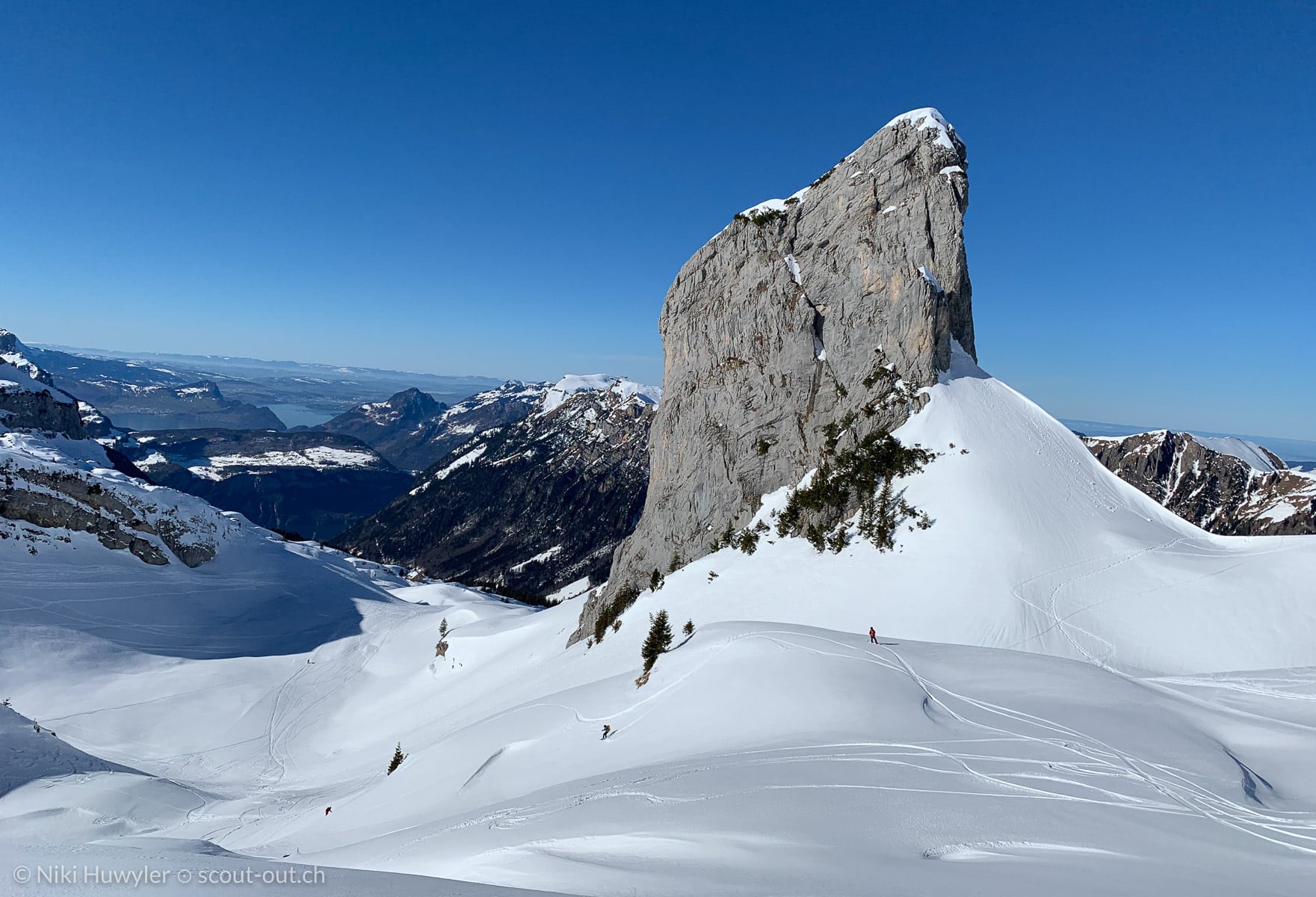
    Abfahrt vom verschneiten schönen Zwölfihorn.

    Apart from the conditions and your own riding ability, it can be said that good beginner tours should include the following:

    • Adapted vertical meters in flatter terrain without drops or narrow sections.
    • Abort the tour and turn back at any time
    • The danger spots are clear and the avalanche danger is low due to the steepness (less than 30°)
    • The weather and conditions are good

    What is the difference between ski touring and splitboard touring?

    Splitboard tours differ somewhat from ski tours. The material is obviously different, which has an effect on walking and riding. Longer traverses in particular are more uncomfortable for splitboarders, whether up or down. The same goes for dragging routes or plate air rides. An adapted route specifically for your needs therefore makes sense.

    Basic physical condition

    Of course, you need a basic level of physical fitness for ski and splitboard touring so that you can make it to the summit. For a beginner's tour, it is said that you should manage around 600-800 vertical meters in 360hm per hour. In summer, this corresponds to around 300 vertical meters when hiking.

    Where and how can I learn to ski tour?

    You can learn how to snowboard in deep snow in snowboard courses with a freeride focus. There are countless offers from snowboard schools, and we also offer such technique courses. Good riding technique is a basic prerequisite for building on this with a touring course.
    As far as touring know-how is concerned, the Alpine clubs and various Alpine schools, and of course we too, offer excellent basic and advanced courses. Our specialty is that we all ride splitboards ourselves. Alpine clubs or alpine schools tend not to. This can have an effect on the choice of tour, such as traverses, flat spots or vertical meters. And of course there's nothing wrong with having really competent friends who can teach you how to tour. However, it is often difficult for a beginner to judge whether a friend is competent or not; and often the imparting of knowledge falls by the wayside on a special tour because it is simply about having fun. Anyone who entrusts themselves to a friend or acquaintance should therefore always question their actions. Not out of mistrust, but simply because you need to know why the other person is making the decisions they are, why they are going left and not right, why this slope is now "safe" and the other is not. Otherwise you won't learn anything on a tour. In addition to our courses and tours, you can acquire knowledge from books and reliable internet sources.
    And of course you can also take a private guide (instead of the courses). Walking with skins is relatively easy, but hairpin turns require specific practice from the splitboard touring beginner in order to achieve a good technique.

    Practice converting from a split to a snowboard in the dry. It is usually cold and windy on the summit. Fitting climbing skins sounds easy, but if they are fitted incorrectly or not optimally, the ascent can quickly become tricky and/or strenuous. Practicing on suitable piste tours would be the next step.


    But now let's get started with our recommendations:

    The link to WhiteRisk includes the snowboard version with GPS track. Nevertheless, the choice of route must always be decided anew on site due to the conditions. Our tour suggestions are also suitable for children and, of course, for ski tourers.

    Which tours are suitable?


    Splitboard Beginner Tour Ibergeregg

    Laucherenstöckli

    An easy and regularly visited classic tour entry point, which is also popular with tourers when snow is scarce. The panoramic summit (summit at 1755m) is away from the ski slope and lifts. The playful but flat terrain is ideal for snowboarders.

    Ascent: 620m 1.30 - 2h
    Orientation: north-east to north-west

    Link to WhiteRisk with the GPS track: https://whiterisk.ch/tour/niki/11403384

    Link to the official SAC tour (a paid account may be required)
    sac-tourenportal/3403/skitouren/2976/

    Splitboard Beginner Tour Davos Pischa

    Pischa via Mattjischtäli

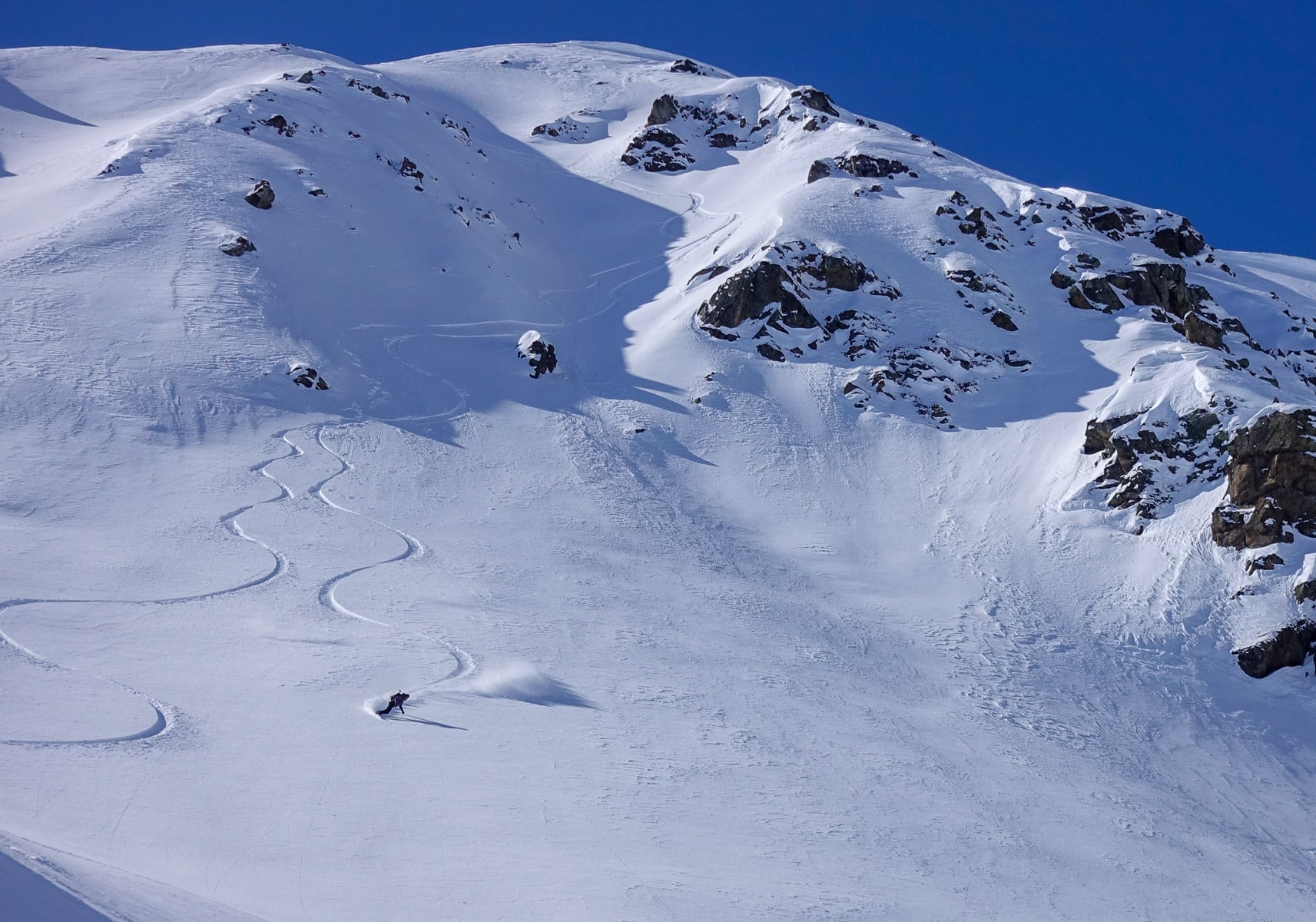
    Away from the hustle and bustle of the slopes despite the cable car support. The Pischa summit can be skipped. Despite its beautiful view, the ascent ridge is often blown off. The descent via Mattjisch Täli in the Flüela valley over gentle terrain is easy to reach via the saddle at P.2835. The key sections are the transition to the "Verborgen Pischa" at P.2593, which can be easy depending on the track, but is difficult for splitboarders. It is best to walk down the 20m. On the descent, it is important to find the right gully/ridge from 2300m. Many are too steep or too overgrown. Pay attention to the GPS!

    Ascent: 380m 1:30
    Descent: 950m
    Orientation: south-east

    Link to WhiteRisk with the GPS track: https://whiterisk.ch/tour/niki/3919032

    Link to the official SAC tour (a paid account may be required)
    sac-tourenportal/pischahorn-5073/skitouren/abfahrt-durchs-mattjisch-taelli-ins-flueelatal-41559/

    Splitboard Beginner Tour Zwölfihorn

    Twelfth horn

    The easy tour leads over extensive and forest-free alpine terrain up to an inconspicuous hilltop in the immediate vicinity of the striking Piz Beverin. If the snow conditions are suitable, you can extend the descent by a few more meters and swing down to Zillis. Thanks to the alpine terrain, this is also possible when there is little snow.

    Ascent: 700m 2h
    Orientation: south-east

    Link to WhiteRisk with the GPS track: https://whiterisk.ch/tour/niki/3429914

    Link to the official SAC tour (a paid account may be required)
    sac-tourenportal/6180/skitouren/2564/


    Splitboard Beginner Tour Tanzboden

    Dance floor

    When there is snow, even at lower altitudes, the Tanzboden is a popular ski and snowshoe tour destination in high winter, even in poor weather conditions. The wide grassy knoll of the Tanzboden is the most important tourist attraction north of the Speer and is "crowned" by the Tanzboden mountain inn, which is open all year round.

    Ascent: 710m 1 - 2:30h / with ski lift use minus 250 vertical meters and a good 1h less
    Orientation: North - North-East

    Link to the official SAC tour (a paid account may be required)
    SAC-skitouren/ab-ebnat-kappel-oder-himmelstoerli-ende-tanzbodenlift-2611/

    Splitboard Beginner Tour Chlei Chrüz

    Chrüz with departure to Gadenstätt

    At St. Antönien, the Chrüz is easy to see and reach. The sun-exposed route first leads through the forest via the winter hiking trail. From Stafel Valpun, follow the ridge to Chlei Chrüz. The very avalanche-prone Chessi hollow should be avoided at all costs. The main summit can be safely omitted, the Chlei Chrüz at 2102m is more interesting for splitboarders. Caution. The ascent ridge can be tricky depending on the conditions. The descent leads down its eastern slopes to the tree line. Now turn right and through a forest aisle past the huts of Alpanova (1600 m). Continue south-east over open terrain towards Heldstabe as far as Gadenstätt and the post bus stop at P. 1276 on the St. Antönierstrasse. Depending on the snow, even as far as Pany.

    Ascent: 740hm 2:20h
    Orientation: north-west
    Descent: 920hm
    Orientation: south-east

    Link to WhiteRisk with the GPS track: https://whiterisk.ch/tour/niki/220836

    Link to the official SAC tour (a paid account may be required)
    sac-tourenportal/394/ski_tour/4600

    Splitboard Beginner Tour Flumserberg

    Erdisgulmen near Flumserberg

    The Flumserberg area offers excellent touring opportunities. Ideal for anyone who wants to gain their first experience of ski touring. Many meters of descent thanks to the cable car support. The tour up to the pre-summit of Erdisgulmen leads over easy terrain, but a clever choice of route is important for safety, as some of the slopes above are steeper than 30°. Descent over beautiful hilly terrain with a mini halfpipe to Alp Fursch for a coffee and cake stop and then back to the ski area.

    Ascent: 530hm 2h / 350hm if start from Leist
    Orientation: East
    Descent: 700hm / 1300hm if to Prodalp-Tannenboden

    Link to WhiteRisk with the GPS track: whiterisk.ch/tour/niki/736252

    Link to the official SAC tour (a paid account may be required)
    SAC-flumserberg-bergstation-maschgenkamm-3475/

    Splitboard Beginner Tour Redertengrat

    Redeten ridge from Lake Wägital

    A popular, easily accessible splitboard tour at the back of the Wägital. Wonderful views of the Wägitalersee and Fluebrig. Easier and more secluded than the much-visited Mutteristock. Caution: The karst terrain should be well snowed in. Otherwise there is a risk of nasty scratches. It's a good thing that this area is one of the wettest in the region. Depending on the route chosen, the ascent through the forest can be challenging. Hardly at risk of avalanches if the tracks are laid wisely.

    Ascent: 1290hm 4 - 4:30h
    Orientation: North-West
    Descent: 1290hm / can be reversed at any time from Rinderweid.

    Link to WhiteRisk with the GPS track: https://whiterisk.ch/tour/niki/164692

    Link to the official SAC tour (a paid account may be required)
    sac-tourenportal/raedertenstock-redertenstock-1481/skitouren/vom-waegitalersee-4929/

    Attention: Even supposedly avalanche-safe tours require specialist knowledge for touring. Weather, conditions and the human factor require well-structured planning, even for beginner tours

    Touring involves risks. It is almost impossible for beginners to assess them properly. My recommendation:

    • Improve your skills: Skiing in different types of snow and shapes. And all this on different slope inclinations. The whole thing is great for practicing in a ski resort.
    • Test your equipment: Do you like touring at all? Join a group. I would hire the equipment first. Make sure you get good advice. The equipment for touring is versatile and more extensive than on the piste.
    • Professional competence: Knowledge of the dangers and their consequences is the key to safe touring. Read up on the subject in the literature and, even better, on tours advertised for this purpose.

    What will I learn in the course?

    This may not apply to every touring course, but in principle you probably learn about the same thing on most of my courses. This includes the following:

    • Glueing and stowing climbing skins correctly
    • Adjust skis, snowboard boots/splitboard bindings for walking and riding incl. climbing aid.
    • Height adjustment for the touring pole and correct holding height
    • Checking and using the avalanche transceiver, shovel and probe
    • Use of crampons and their assembly
    • Introducing and practicing hairpin bends
    • Run, enjoy, powder, enjoy nature
    • Avalanche awareness, planning, orientation etc.

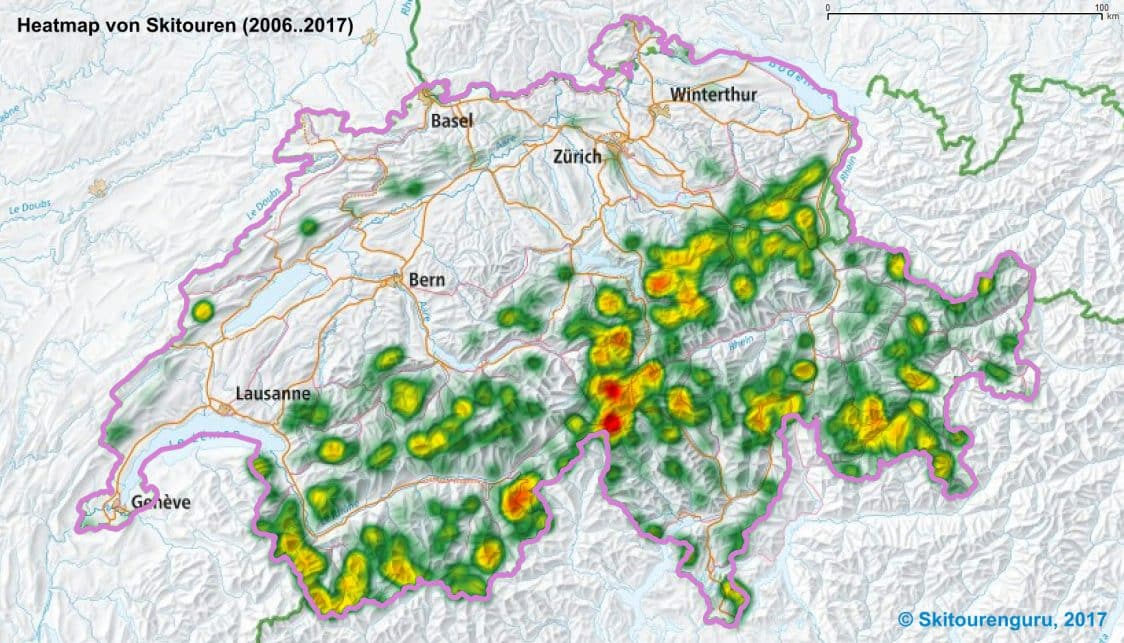
    One way to find other popular tours is to use the numerous headmaps, e.g. on Strava. A heat map shows hotspots (red) where a particularly large number of ski tours have been recorded. However, this does not mean that they are also suitable for beginners. Professional competence on tours is and remains an important point.

    Figure: Heatmap of a collection of GPS tracks of ski tours from the period 2006-2017Figure: Heatmap of a collection of GPS tracks of ski tours from the period 2006-2017. Base map from © Swisstopo
    Niki also has other tour recommendations:
    -> The most beautiful multi-day tours
    -> The most beautiful T4 - T6 hikes
    -> The most beautiful climbing routes
    -> The most beautiful bike tours

    You can find the tools we use at: www.snowboardcoach.ch/tourenplanung/

    Our tours and events, especially beginner-friendly:

    1
    GOPR0138
    12
    Dezember

    Powderday - Start in den Winter

    Date:
    Samstag, 12 Dezember, 2026
    Time:
    9:40 am - 3:00 pm
    Veranstaltungsort:
    Oberiberg
    Guide:
    Niki Huwyler
    Ticket:
    CHF180 Purchase Now - 7 Places Left

    2. Dezember 2026 – Tourenstartday: Wir machen uns auf die Suche nach dem Pulverschnee

    More Info
    1
    Freeriding beim Tourengehen
    13
    Dezember

    LVS- und Beginner Tour

    Date:
    Sonntag, 13 Dezember, 2026
    Time:
    9:30 am - 3:00 pm
    Veranstaltungsort:
    Flumserberg Gebiet
    Guide:
    Niki Huwyler
    Ticket:
    CHF180 Purchase Now - 7 Places Left

    13. Dezember 2026 – LVS und Tourenkurs speziell für Einsteiger, geeignet für Ski- oder Splitboarder im Spitzmeilengebiet.

    More Info
    1
    Spitzmeilen
    27
    Dezember

    Touren Schnupper Kurs

    Date:
    Sonntag, 27 Dezember, 2026
    Time:
    8:45 am - 3:00 pm
    Veranstaltungsort:
    Flumserberg Gebiet
    Guide:
    Niki Huwyler
    Ticket:
    CHF180 Purchase Now - 7 Places Left

    27. Dezember 2026 – Tagestour im Spitzmeilengebiet mit Liftunterstützung und vielen Abfahrtsmetern.

    More Info
    1
    Rider Board
    30
    Januar

    Kicker Session

    Date:
    Samstag, 30 Januar, 2027
    Time:
    9:00 am - 5:00 pm
    Veranstaltungsort:
    Flumserberg Gebiet
    Guide:
    Niki Huwyler
    Ticket:
    CHF100 Purchase Now - 8 Places Left

    30. Januar 2027. Kicker-Session im Spitzmeilengebiet mit kleinem Aufstieg.

    More Info
    1
    Spitzmeilentour
    13
    März

    2-Tage Spitzmeilen

    Date:
    März 13 - Sonntag, 14 März, 2027
    Time:
    9:00 am - 5:00 pm
    Veranstaltungsort:
    Flumserberg Gebiet
    Guide:
    Niki Huwyler
    Ticket:
    CHF440 Purchase Now - 7 Places Left

    13. – 14. März 2027. 2 Tage im Spitzmeilengebiet: Tourenkurs mit Übernachtung in der SAC‑Spitzmeilen-Hütte

    More Info
    Radical Stories: In conversation with Andy Tanner, founder of Beach Mountain and +Alprausch

    Radical Stories: In conversation with Andy Tanner, founder of Beach Mountain and +Alprausch

    Allgemein @en, Company, Snowboard

    We are delighted to welcome André "Andy" Tanner, one of the formative pioneers of the European snowboard scene, for an interview.

    Andy Tanner, former Sims Pro rider, is the founder of Beach Mountain and the lifestyle brand +Alprausch. As a passionate snowboarder, he has shaped the scene both on and off the slopes by introducing innovative ideas into snowboard culture and the fashion world.

    In an exclusive interview, Andy gives us exciting insights into the beginnings of snowboarding, his personal highlights and the development of the scene over the last few decades.

    Look forward to inspiring stories and anecdotes from the time when snowboarding was still a crazy adventure.

    The picture shows José Fernandes today. The snowboard pioneer par excellence.

    Picture: Andy Tanner, Sims Pro rider and founder of Beach Mountain and +Alprausch

    ... Today I feel extremely grateful that I was born in an era when all these cool sports were created and developed. ...

    Please introduce yourself briefly.

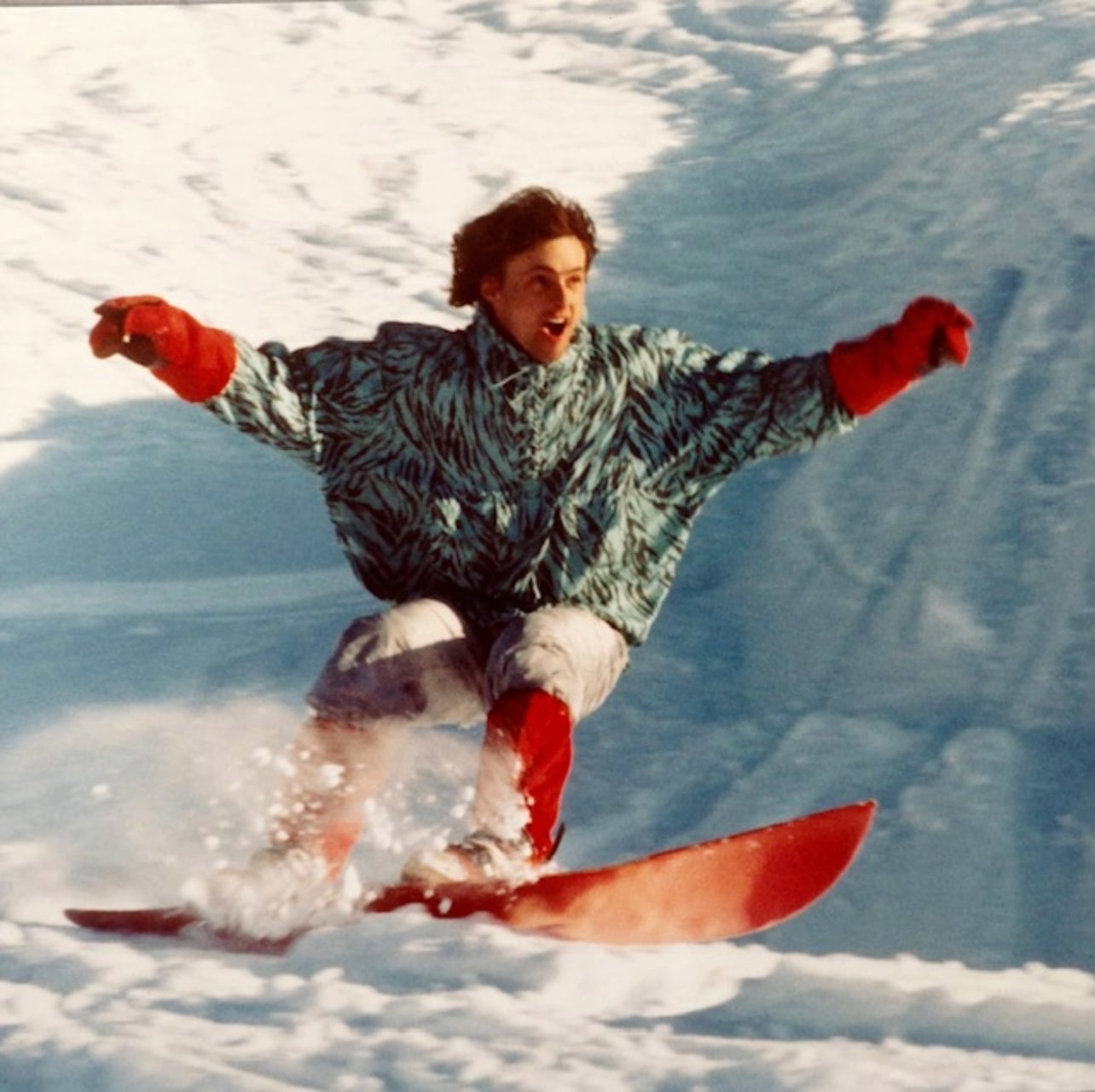
    My name is Andy Tanner, I'm from Zurich, I was born in 1960, so I'm older, I'm a skateboarder and snowboarder and I'm still on the board... It all started with skateboarding.

    I had my first skateboard in 1973, a "plastic thing". Then I was lucky enough to be able to travel to California in 1975, where I naturally caught the skateboarding bug. From the mid-70s, the worldwide skate boom developed, including in Switzerland. The first clubs were founded and championships were held.

    Competition was never really my thing - rather freespirit skateboarding in various facets. Today I feel extremely grateful that I was born in an era in which all these cool sports were created and developed. We were young, had an endless belief in the future, wanted to have fun, move around and really "lived" skateboarding and subsequently snowboarding. The fascination for it still exists.


    Andy Tanner - First board, location Hoch Ybrig 1983

    Caption: My first snowboard - a piece of molded wood with steel fins and "bindings" ordered from Tom Sims in the USA, ridden with Sorel boots. Location: Hoch-Ybrig, 1983/84.

    What was it like to be there in the early days of snowboarding?

    Of course, you can't compare snowboarding in the past (80s) with today. It was exotic, we were very few and not at all popular in the ski resorts. With the "snowboards" of that time, it was only possible to board in deep snow - no edges - fins and foot straps as bindings... Just "crossing" a slope was a risk.

    Snowboarding was a real revolution - on snow - not "riding in the snow", but "surfing in the snow", across - on a board. A fascination for me that still continues.

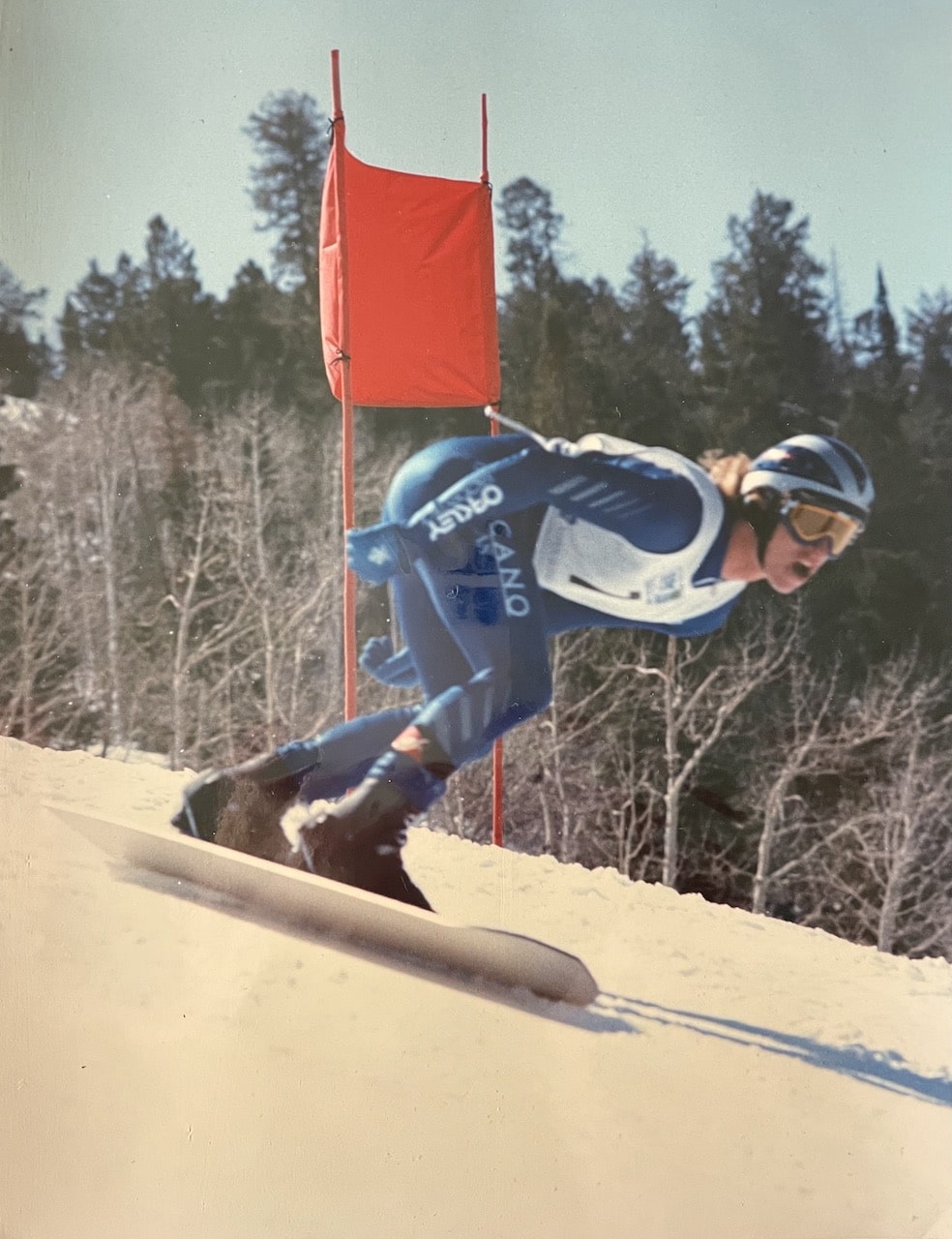
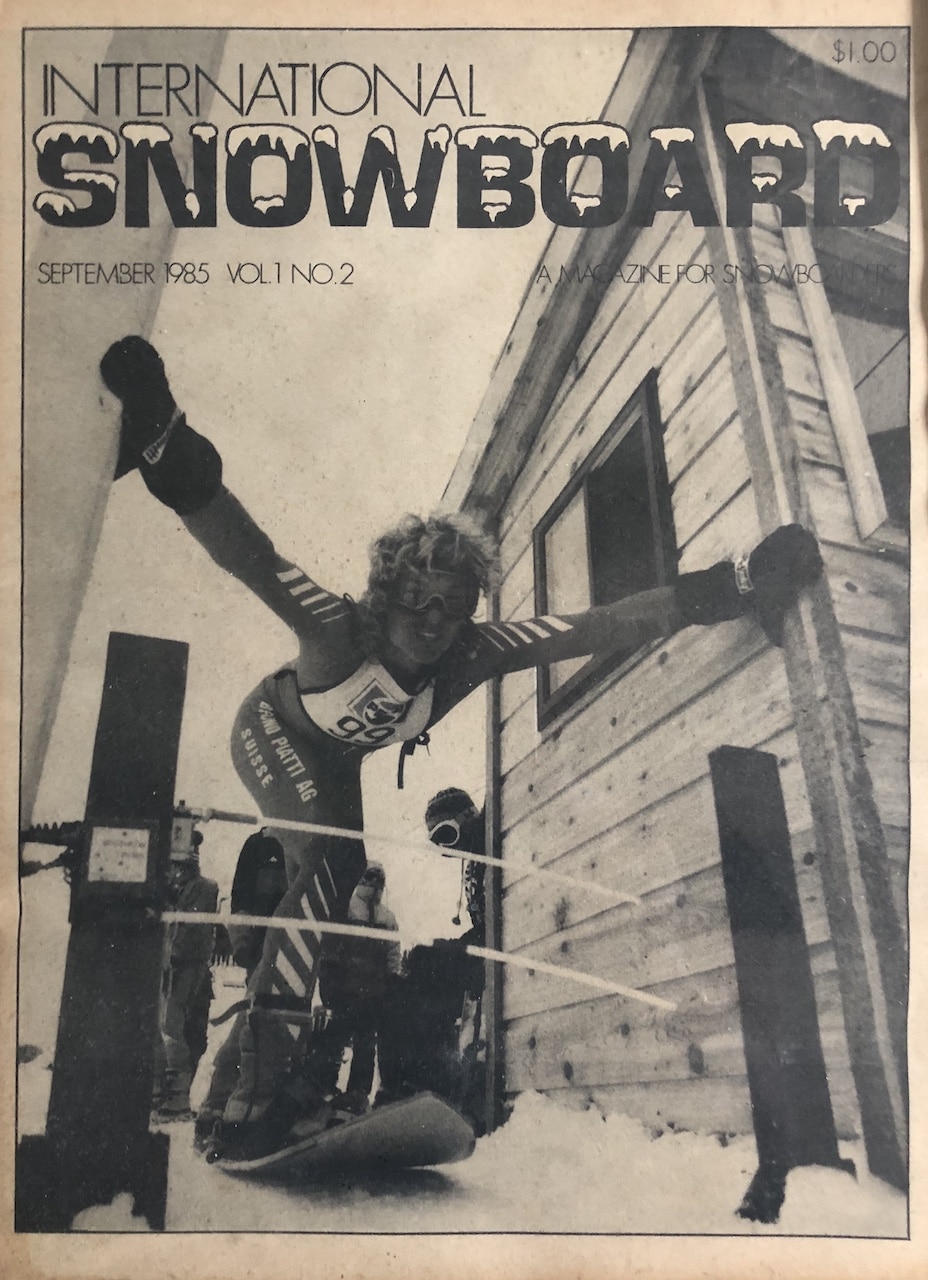
    Andy Tanner 1985 Breckenridge USA
    Andy Tanner Hawaii Big Island Maua Kea First Descent 1984

    Captions:

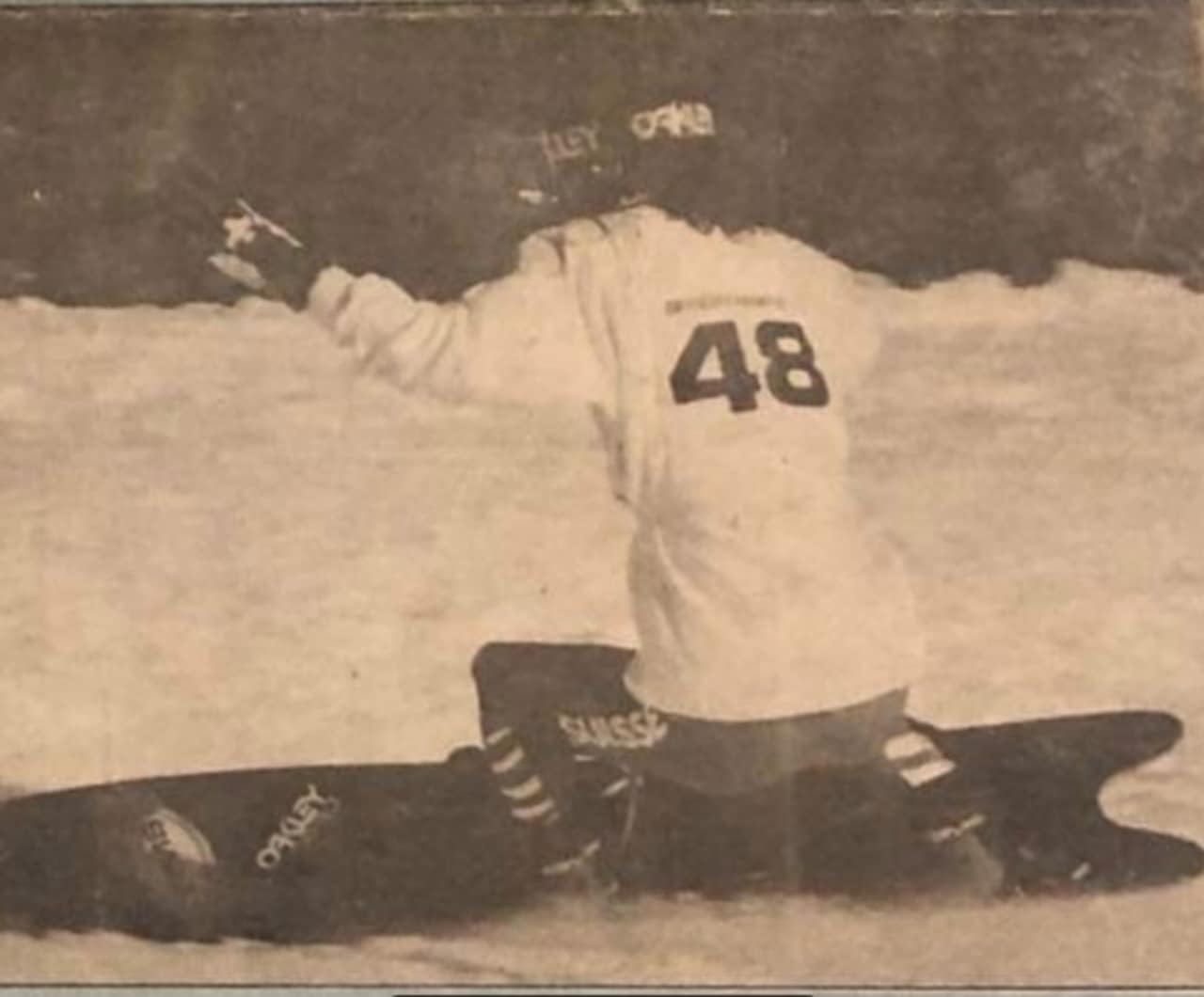
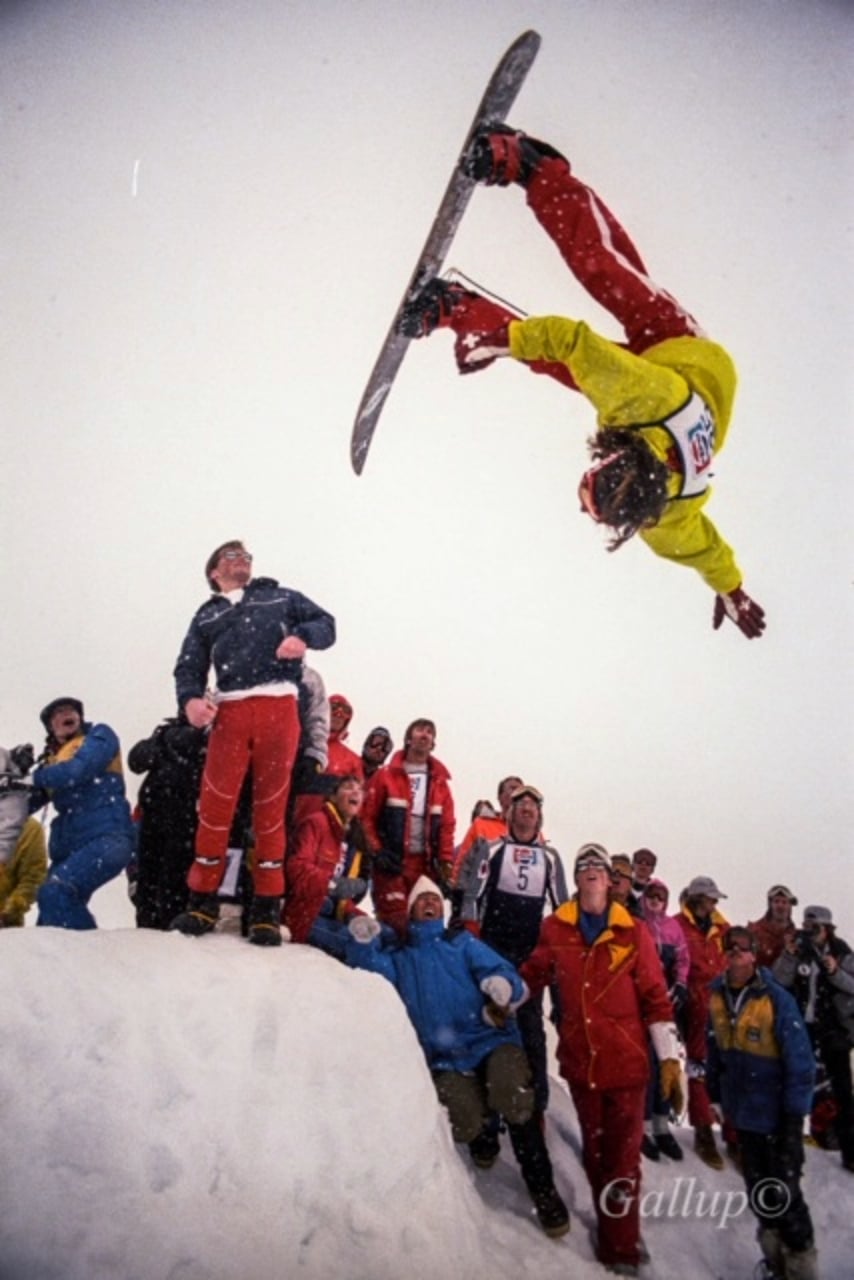
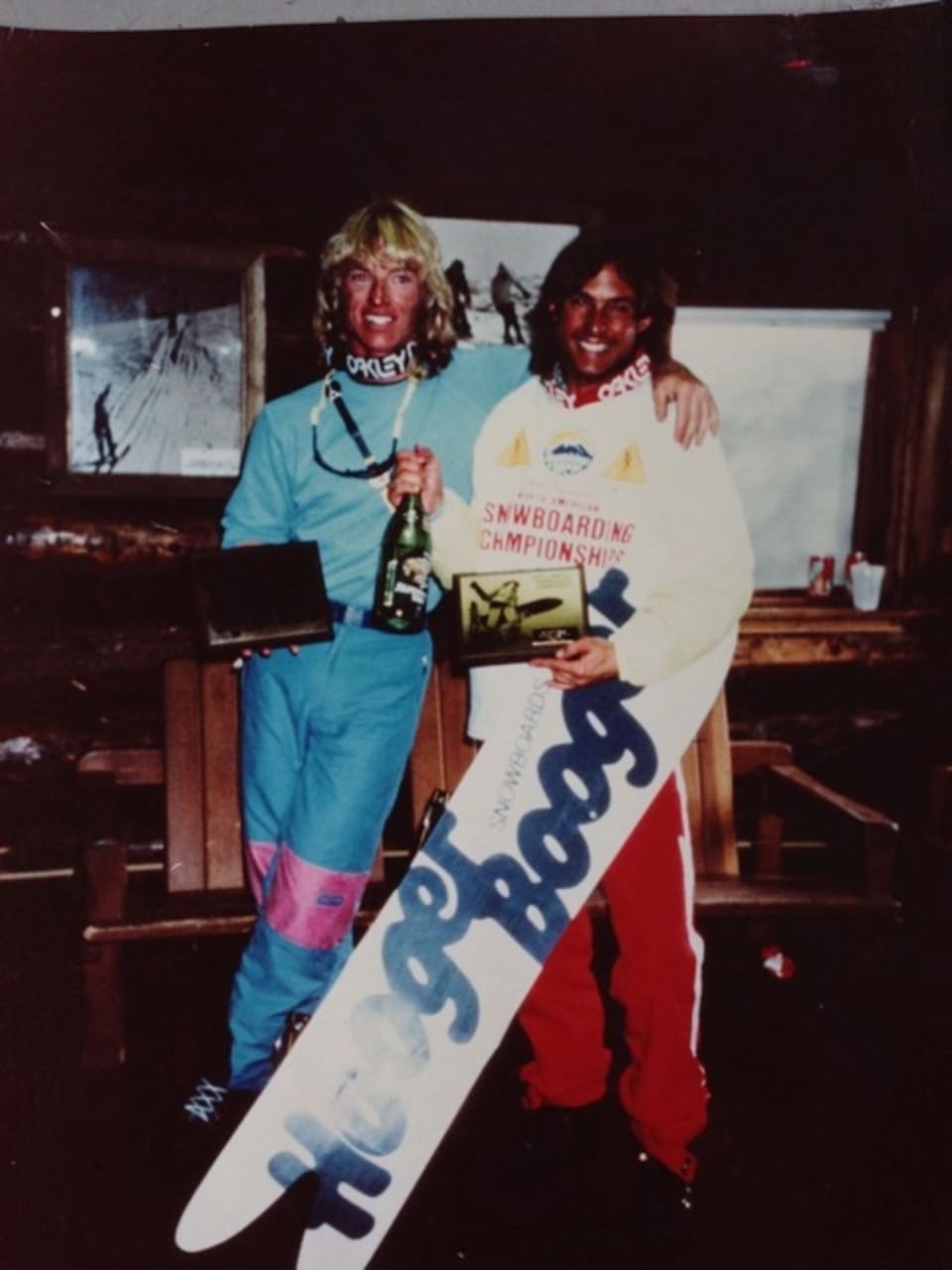
    1. WORLDCHAMPIONSHIPS - Breckenridge, Colorado, USA 1985
      Caption: Andy Tanner at the Snowboard World Championships in Breckenridge, Colorado, USA, 1985.
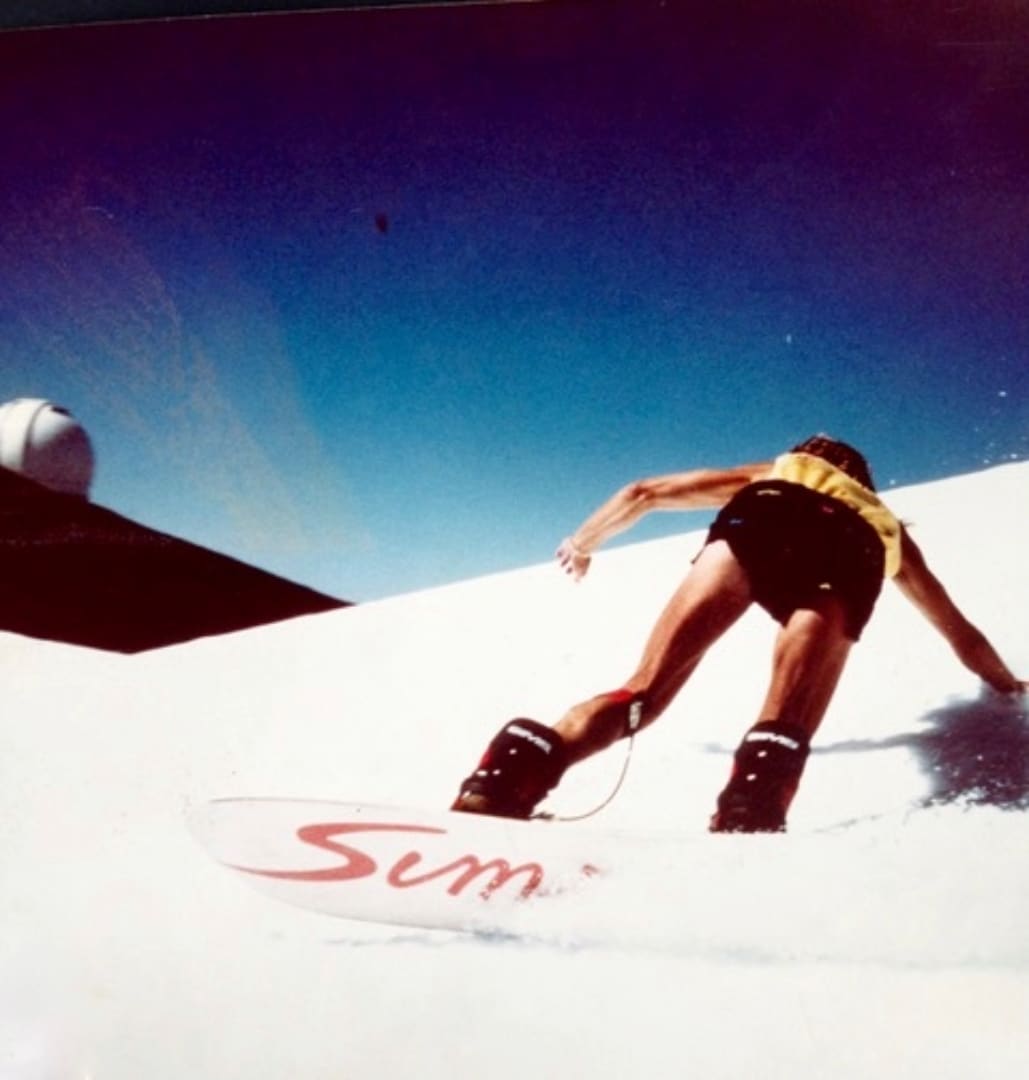
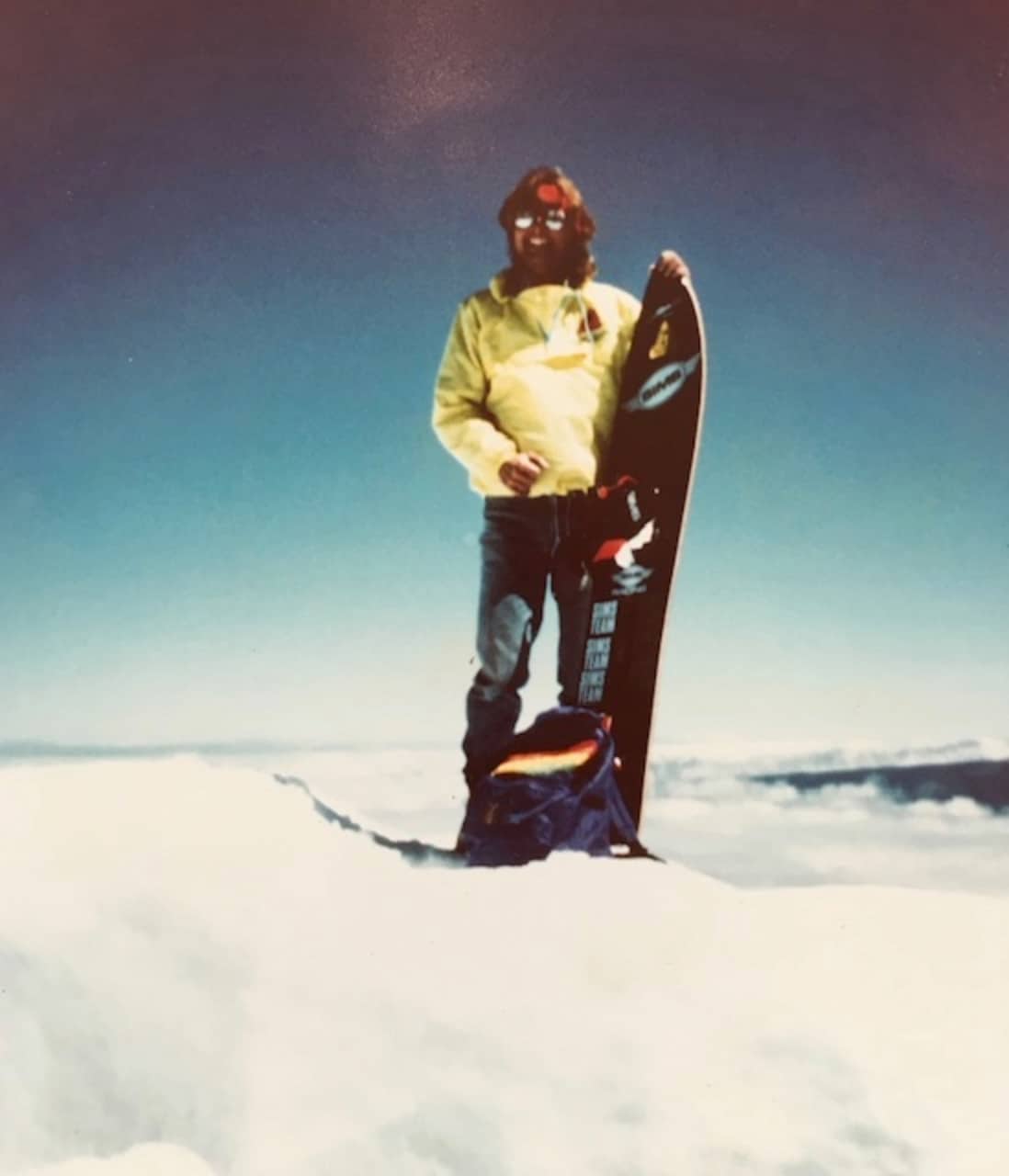
    2. FIRST DESCENT - Into the crater at 4200 m, Mauna Kea, Big Island, Hawaii, 1984/85
      Caption: Andy Tanner's first descent into the crater of Mauna Kea at 4200 m, Big Island, Hawaii, 1984/85.

    What was the story behind the founding of Beach Mountain?

    As quasi "first generation" snowboarders, Jose Fernandes and I were the first Europeans to travel to the USA and Canada to take part in the snowboard competitions. That was in 1985 and 1986. The Americans had invented the snowboard and were therefore already further along in the snowboarding "movement".

    After returning from overseas, a whole winter of "snowboarding" and a title: North American Champion, and total enthusiasm for it, I spontaneously decided to open Switzerland's and Europe's first snowboard store - Beach-Mountain - in Zurich in 1985. At this point it should also be noted that snowboarding developed from the cities with a background in skateboarding and not from the mountain regions.

    Back then, you couldn't buy snowboards anywhere in Europe. You had to contact the first manufacturers in the USA, etc. Right from the start, there was huge interest in the store and the new, revolutionary action sport of snowboarding. In addition to the hardware that I imported and sold from the USA, I added clothing, outerwear and, of course, skateboards in the summer.

    As a result, the Beach Mountain was more than just a store where you could buy snowboards and everything that went with them - it was a real meeting place for interested, like-minded and fascinated people. The "Beach" became a hot spot for people from all over Switzerland and abroad.

    Back then, we also organized movie nights at the Volkshaus with snowboard, surf and skate films. The Volkshaus was always totally full. Later on, the Beach Mountain always had visits from snowboard pros from all over the world, where we organized meet and greets. In retrospect, it's fair to say that the Beach Mountain store in Zurich made a significant contribution to the development and spread of snowboarding in Switzerland and Europe.

    Andy Tanner North American Championships Canada 1984
    Andy Tanner Pro Rider Sims Snowboards Hawaii Gipfel Mauna Kea 1984
    Andy Tanner Winner of best Manouvre North American Championships 1985

    Captions:

    1. North American Championships, Canada, 1984/85
      Caption: Andy Tanner at the North American Championships in Canada, 1984/85.
    2. Best Manouevre of Contest, North American Championships, 1985
      Caption: Andy Tanner winning the award for "Best Manouevre of Contest" at the North American Championships, 1985.
    3. On the summit of Mauna Kea, Hawaii, 1984/85
      Caption: Andy Tanner on the summit of Mauna Kea, Hawaii, with the special team roundtail sponsored by Tom Sims himself. On the road as a pro rider for SIMS, 1984/85.

    What was the story behind +Alprausch?

    As snowboarding and the market developed, this "lifestyle" became more and more widespread, and the demand for products such as clothing, accessories etc. specifically designed for snowboarding increased. People were now willing - in contrast to the past, when everything had to come from the USA - to take an interest in products from the "local garden".

    So the time was ripe for +Alprausch, the brand for snowwear, streetwear and accessories with a touch of Switzerland. Created by riders for riders. With good quality, a connection to the Swiss mountain landscape and outdoor lifestyle. Sustainably produced in Europe, long before sustainability was the buzzword. To my own surprise, the brand really took off and we were able to delight fans and friends worldwide with our creations.

    As a result, we were able to open six +Alprausch stores and were on the market with retailers in 10 countries. Now 23 years have passed since the brand was founded and it is still on the market - the story continues.

    ... once a "Brättlibueb - always a "Brättlibueb ...

    Are you still active on the snowboard?

    I'm still snowboarding at the age of 65 and haven't switched to skis like most of my friends. My aim is to board for as long as possible. I'm also active on the skateboard... once a "Brättlibueb" - always a "Brättlibueb"... life moving sideways.

    The fascination has remained the same, only the body is slowly not allowing as much as it used to.

    Enthusiasm, active commitment, passion and a bit of rock-n-roll are attributes that were the driving force behind the creation at every stage.

    We have been running a unique event location in our +Alprausch-Fabrik in Zurich's Kreis 3 district for some time now. Where we have had our offices, showroom, warehouse etc. for 35 years. A location where you can organize company dinners, birthdays, presentations, etc.

    Our latest concept is Rocket Gran, the somewhat different wool store. Nicole, my life partner, prototype designer and knitting and crochet luminary, inspired us to create it.

    Andy Tanner und Jose Fernandes Hooger Booger Katalog 1986

    Caption: Andy Tanner and José Fernandes, both sponsored for the Hooger Booger catalog in 1986. Andy knew José, a true legend of the scene and one of the first snowboard world champions, very well.

    How did you experience the founding and development of Radical?

    When Radical was founded, I was an active member with Mark Farner. I can still remember very well how Mark and Marco Franzoni built the first handmade snowboards in the basement of the old villa on Bellariastrasse in Zurich. Wood and fiberglass, laminated like surfboards, swallowtail with loop bindings and giant fins on the sides. From then on, things progressed rapidly. The slide slides that we shot from our deep snow rides on weekend snowboard trips in Hoch Ybrig or Andermatt were celebrated on long evenings on Bellariastrasse in Zurich, which awakened our hunger for more boards and powder.


    In your opinion, how did the 1987 World Championships in St. Moritz influence the further development of the sport?

    Radical was one of the key brands in the history and development of snowboarding in Switzerland. With tireless enthusiasm, Mark Farner has been committed to this new sport from a very early stage.

    With the organization of the World Championships in 1987, the "sport" of snowboarding arrived with a lot of media presence and coverage, with fantastic, dynamic images, even on TV for the "normal citizen". The following winters then triggered the great "snowboard revolution".

    Are there any special moments or anecdotes with Mark Farner that you would like to share with us?

    There are of course a few special moments with Mark Farner. The most important are the ascent in Hoch Ybrig at the end of the Sternen lift, walking through the deep snow up to the ridge, marveling at the panorama and the slope in front of us and then enjoying the "Weglosen" with big powder turns. Moments like these stay in your memory for a lifetime.


    Would you like to send us a message to celebrate Radical's 40th anniversary?

    Congratulations on 40 years of Radical! An impressive and unusual success story and a brand that has played a key role in the "snowboard revolution" and continues to do so.

    Thank you very much for the interview Andy!

    The picture shows José Fernandes today. The snowboard pioneer par excellence.

    Picture: André Tanner - still a creative and versatile maker today.

    The current Radical collection

    • Radical Freecarver Snowboard. Ein Board für alle Hardboot Carver.

      Freecarver 3.0

      CHF 1'498 .-
    • Das Radical Rider Snowboard mit seinem zeitlosen Design ist eines der besten Allround Snowboards der Welt.

      Rider 3.0

      Bewertet mit 5.00 von 5
      CHF 1'498 .-
    • Angebot! Snowflake Splitboard 3.0

      Snowflake Splitboard 3.0

      CHF 1'598 Ursprünglicher Preis war: CHF 1'598CHF 1'298Aktueller Preis ist: CHF 1'298. .-
    • One of Ten | Board

      One of Ten | Board

      Bewertet mit 5.00 von 5
      CHF 1'998 .-
    • Radical Surf Snowboard. Ein Longboard für alle Freaks. Mit echtem Nussbaum Holzfurnier als Design.

      Surf 3.0

      Bewertet mit 5.00 von 5
      CHF 1'498 .-
    • Scout Splitboard

      Scout Splitboard

      Bewertet mit 5.00 von 5
      CHF 1'598 .-
    • Das Radical Shark Snowboard mit Swallow Tail und Spoon Nose.

      Shark

      Bewertet mit 5.00 von 5
      CHF 1'398 .-
    • Das Radical Rider Splitboard 4.0 beeindruckt mit hochwertigen Materialien und einem zeitlosen Design.

      Rider Splitboard 4.0

      Bewertet mit 5.00 von 5
      CHF 1'598 .-
    • Snowflake Splitboard 4.0

      Snowflake Splitboard 4.0

      Bewertet mit 5.00 von 5
      CHF 1'598 .-
    • Das One of Ten Snowboard 2025 mit pinken Elementen auf Carbon. Ein limitiertes Meisterwerk.

      One of Ten | Board

      Bewertet mit 5.00 von 5
      CHF 1'998 .-
    • Das Radical Double X 2.0 ist das Carving Board für ambitionierte Rider.

      Double X 2.0

      Bewertet mit 5.00 von 5
      CHF 1'498 .-
    • Snowflake 3.0 – das ultimative Allroundboard für Frauen, erhältlich im weissen oder schwarzen Design.

      Snowflake 3.0 schwarz oder weiss

      Bewertet mit 5.00 von 5
      CHF 1'398 .-

    Radical Legends: Our story, told by those who shaped it

    To mark our 40th anniversary, we took a trip down memory lane and visited a few selected Radical legends from our eventful history.

    It is with great pleasure that we invite you to immerse yourself in history with us and relive the special moments. We will be publishing more exciting conversations until the end of winter - so stay tuned and be inspired!

    Have you been with us from the start or do you have a question? Share your thoughts with us - we look forward to your comment!

    Radical Stories: In conversation with José Fernandes, the first snowboard world number 1 from Europe.

    Radical Stories: In conversation with José Fernandes, the first snowboard world number 1 from Europe.

    Allgemein @en, Company, Snowboard

    We are proud to welcome snowboard legend José FernandesEurope's first world champion, for an interview.

    In an exclusive interview, José gives us exciting insights into the beginnings of snowboarding, his personal highlights and the development of the scene over the last few decades.

    Look forward to inspiring stories and anecdotes from the time when snowboarding was still a crazy adventure.

    The picture shows José Fernandes today. The snowboard pioneer par excellence.

    Caption: José Fernandes, the first snowboarding world champion from Europe, shaped the snowboarding scene like no other and is a true legend.

    ... Snowboarding was for us in winter sports what rock'n'roll was in the music world. Anti-establishment. ...

    Please introduce yourself briefly.

    My name is José Fernandes, son of a Swiss mother and a Portuguese father. I went to primary and secondary school in Wallenwil/Eschlikon TG.

    The hills of the "Hinter-Turgi" were my playground. Skiing, skateboarding, cycling and then, at some point in the late 70s, my first attempts at snow with an ironing board, which eventually became the first snowboards.


    When and how did you first get to know Radical?

    The Radical Snowboard Club Zurich was the first point of contact, at the same time as the first boards that Mäge Farner had built. In 1986, the first CH championships in St. Moritz and a somewhat angry Tom Sims, who was not so amused by the shape of the first Radical models.

    A long friendship with Mäge began. Mäge was soon to build my prototypes for the competitions. That was when I was a Sims team rider and then also a Renault Snowboards rider...

    Tell us about the Goldvreneli Board.

    Together with Radical, we were ahead of our time and designed a board that would cost well over CHF 2,500. All in black, with a gold vreneli embedded in the shovel and gold-plated Fritschi plate bindings. There was also a long aluminum case for stylish storage and transport.

    Needless to say, nobody wanted the thing and not a single model was sold. A few years later, the two models were stolen from my garage in Nice and never turned up again.


    Jose Fernandes Goldvreneli Board by Radical

    Caption: José Fernandes with the legendary Goldvreneli board, a special model manufactured by Radical.

    Can you remember the first time you saw or tried out a snowboard?

    The Swiss Landsurfers Club (skateboard club from Zurich) was the main place where the first pictures from American skateboard magazines were passed around. There was no video, YouTube or Google yet. Only photos.

    Then everyone made their own at home. A skateboard with two small skis under the axles. You could only ride straight ahead and practise handstands. Aluminum-wood-aluminum laminates from the Swissair workshop were the first boards that worked successfully in deep snow. First Sims snowboard ordered from the USA. Without steel edges, without a base, without bindings, but with three fins... The snowboards "Made in the USA" lasted about three weekends before they delaminated and disintegrated.

    But the feeling when we realized that we were having far more fun than skiers with enough powder snow, steep and virgin slopes, was unstoppable with our happiness hormones and endorphins.


    What was it like to be there in the early days of snowboarding?

    In the beginning, it was an incentive to continue skateboarding during the long winter months and on wet roads. Hence the sneakers with plastic bags as footwear. But it soon became clear that the opportunities to explore and show off our mountain world in Switzerland with these new "ironing boards" fired our imagination and it was our chance to be different. Snowboarding was to us in winter sports what rock'n'roll was in the music world. Anti-establishment.

    Jose Fernandes Gletscher Abfahrt
    Jose Fernandes Slalom 80er Jahre
    Jose Fernandes Wettkampf 80er Jahre
    Jose Fernandes Titelbild Snowboard Magazine 1985

    Captions:

    1. Glacier descent
      Caption: José Fernandes during an impressive descent on the glacier.
    2. Slalom training with poles
      Caption: José Fernandes during intensive slalom training with poles - perfecting the technique for the competition.
    3. Downhill competition
      Caption: José Fernandes in full action during a competition downhill - speed and precision at the highest level.
    4. José Fernandes on the cover of Snowboarding Magazine, 1985
      Caption: José Fernandes, the first snowboarding world champion from Europe, on the cover of Snowboarding Magazine, 1985 - a milestone in his snowboarding career.

    ... No, no, you're not going up there with those skirmishes! ...

    Are there any special moments from the early days of snowboarding that you would like to share with us?

    I think the list is endless. There are thousands of stories. It's really difficult to dig up one or two stories. But perhaps the story about the bribery strategies of lift staff in almost all ski destinations.

    Buying tickets was still quite normal. But when we got close to the lift guys with our boards, we were told ... "No, no, you can't go up there with those skis!"

    It's almost impossible to imagine today. But that was our everyday life. So we decorated chocolates and wine bottles with snowboard labels and bribed the boys. And where that didn't help, we cut off the tips of old skis, fitted the bindings to the front and put them on for transportation, then stowed them away in our rucksacks ...

    When I flew to America/Canada for the first time in 1985 to take part in a competition, all the Americans from the magazines were there:

    Tom Sims, Mark Heingartner, Andy Coghlan, Terry Kidwell, Bob Klein. They all asked me how many snowboarders there were in Europe. None of them had us on their radar. And then someone like that comes along with sponsors and rides straight onto the podium with the pros and onto the cover of the first snowboard magazine.

    The beginning was characterized by the fact that we all knew each other and helped each other to get material and try out new things. Repairs and new developments during the week were almost as important as the weekend in the mountains. Two runs with four turns, you were the hero. Then it was off to the workshop again because something was broken.

    No wonder I had no time or interest in school and was thrown out of grammar school on edge.


    What are your greatest and most memorable successes?

    To be honest, I have to say the world championship title in 1987 in Breckenridge, Colorado, and sharing the podium with the legend Craig Kelly. But for me, all the titles (World Champion, European Champion, Swiss Champion) and all the other trophies are not more important than the long-standing friendships, the network and the annual contacts with all these great people, the pioneers and legends of our sport, which continue to this day.


    What impact did the World Championships 87 in Livigno/St. Moritz, which Mark and the Radical Snowboarding Club Zurich organized, have had on the sport?

    I think that the Radical Snowboarding Club had already laid the foundations for international competition the year before with the first open Swiss Championships in St. Moritz. The World Championships in Livigno and St. Moritz subsequently brought snowboarding competitions into the media for the first time. Sponsors, prize money and titles for the athletes made professional sport and its rapid development into an Olympic discipline possible.

    Auf dem Bild sieht man Mark Farner und José Fernandes bei der ersten Snowboard Weltmeisterschaft in Europa 1987.
    Slalom Fernandes Snowboard Legende aus den Anfangszeiten
    José Fernandes zeigt wie Snowboarden geht. Sein Körper berührt fast komplett den Boden beim Carven.

    Captions:

    1. José Fernandes and Mark Farner at the 1987 World Championships
      Caption: José Fernandes and Mark Farner at the 1987 Snowboard World Championships - two pioneers of the snowboard scene exchanging ideas.
    2. Carving pose
      Caption: José Fernandes in a powerful carving pose - perfection and style on the slopes.
    3. Laydown
      Caption: José Fernandes doing a laydown - an impressive demonstration of his control and technique in snowboarding.

    What advice would you give young snowboarders today?

    The snowboard story is far from over. If anything, the first cycle has just come to an end. Snowboarding has brought the freestyle lifestyle to the winter sports industry, revitalizing and animating an entire sector of the economy. Now snowboarding is looking for its identity and will reinvent itself, but it is here to stay.

    An old hand like me can only say to young athletes: don't lose the fun and joy of going out on the board every day. Find the intrinsic motivation to be unconventional and to make impossible things tangible and try them out.

    It strengthens the personality and is a basis for all situations in life. Snowboarding is not just a sport, but a way of life.

    The best study program I could get - without a high school diploma ...


    How did you experience the founding and development of Radical?

    As I said, friendships have developed that still last to this day, even if we don't see each other every day. The respect for what we have achieved is mutual and always present. Mäge Farner had set out on his path back then and we followed in his wake. He has remained true to his passion to this day, and that is what makes Radical what it is - then as now.

    Sims had Radical build the race boards for their athletes. Here you can see a small collection of them.

    Caption: Mark Farner and workshop manager Bruno Baeza proudly present the Sims pro boards manufactured by Radical - a significant moment in snowboarding history.

    How do you think Radical has influenced the sport?

    There was a time when Radical made the prototypes of the world's best snowboarders. Incidentally, this is the reason why Jake Burton was never able to persuade me to ride for Burton. My condition was always to be allowed to ride my own boards (Radical from Mäge). Jake didn't want that, and back then Burton boards weren't exactly the crème de la crème ... 😉 Things are different today.

    Mäge with Radical has significantly shaped and driven the development of the boards. Back then, the acceleration in research and development was weekly, not annual.


    How have you experienced the development of snowboarding in Switzerland and worldwide?

    The level of the athletes has become absolutely incredible. I have the utmost respect, especially for the Swiss, who keep at it and deliver top performances in the World Cup. I always enjoy being a guest at the OPEN in Laax. There's nothing like seeing and experiencing the spectacle live. Who would have thought that almost 40 years ago, when we snowboarders still had to shovel our halfpipes by hand.

    Freeride, freestyle, boardercross and halfpipe - everything has its place and brings the sport to television.

    But it is the personal experience of sliding down a slope like the Hawaiians on their wooden planks in the surf when they met Captain Cook that makes them successful.

    This feeling can be practiced with ease by people of all ages and backgrounds - alone or with friends. Above all, this has spurred the breakthrough and is still the reason why so many people are discovering snowboarding for themselves today.


    How do you see the future of snowboarding?

    The snowboard scene is currently experiencing a return to its origins. New concepts, techniques and possibly even new disciplines are emerging from this movement. One example of this is the "Natural Selection" format initiated by Travis Rice, which combines freestyle tricks with freeride art on natural terrain.

    With advanced visualization capabilities and modern 360-degree cameras, snowboarders can capture their experiences in a more immersive way. Cameras such as the Insta360 X4 offer 8K video recording and enable impressive all-round shots.

    These technologies allow us to delve deeper into the world of snowboarding and make the experience even more tangible.

    It remains exciting to see what developments and innovations the future of snowboarding has in store.


    Would you like to send us a message to mark our 40th anniversary?

    Stay alert, don't close yourselves off, remember that your roots lie in the curiosity and tireless drive to try new things of your founder Mäge Farner. Don't be satisfied with second best ... Radical stands for pioneering art and excellence in winter sports.

    Thank you very much for the interview José!

    The picture shows José Fernandes today. The snowboard pioneer par excellence.

    Caption: José Fernandes, today a successful businessman

    Radical Legends: Our story, told by those who shaped it

    To mark our 40th anniversary, we took a trip down memory lane and visited a few selected Radical legends from our eventful history.

    It is with great pleasure that we invite you to immerse yourself in history with us and relive the special moments. We will be publishing more exciting conversations until the end of winter - so stay tuned and be inspired!

    Have you been with us from the start or do you have a question? Share your thoughts with us - we look forward to your comment.

    Discover the latest Radical snowboards here

    • Radical Freecarver Snowboard. Ein Board für alle Hardboot Carver.

      Freecarver 3.0

      CHF 1'498 .-
    • Das Radical Rider Snowboard mit seinem zeitlosen Design ist eines der besten Allround Snowboards der Welt.

      Rider 3.0

      Bewertet mit 5.00 von 5
      CHF 1'498 .-
    • One of Ten | Board

      One of Ten | Board

      Bewertet mit 5.00 von 5
      CHF 1'998 .-
    • Radical Surf Snowboard. Ein Longboard für alle Freaks. Mit echtem Nussbaum Holzfurnier als Design.

      Surf 3.0

      Bewertet mit 5.00 von 5
      CHF 1'498 .-
    • Das Radical Shark Snowboard mit Swallow Tail und Spoon Nose.

      Shark

      Bewertet mit 5.00 von 5
      CHF 1'398 .-
    • Das One of Ten Snowboard 2025 mit pinken Elementen auf Carbon. Ein limitiertes Meisterwerk.

      One of Ten | Board

      Bewertet mit 5.00 von 5
      CHF 1'998 .-
    • Das Radical Double X 2.0 ist das Carving Board für ambitionierte Rider.

      Double X 2.0

      Bewertet mit 5.00 von 5
      CHF 1'498 .-
    • Snowflake 3.0 – das ultimative Allroundboard für Frauen, erhältlich im weissen oder schwarzen Design.

      Snowflake 3.0 schwarz oder weiss

      Bewertet mit 5.00 von 5
      CHF 1'398 .-
    Storing skis + snowboards over the summer

    Storing skis + snowboards over the summer

    Allgemein @en, Ski, Snowboard

    How do I store my skis and snowboards properly in summer?

    The end of the season is approaching and with it the question of how to look after your skis and snowboard after the last run of the season and how best to store your ski equipment.
    With our tips, you will still be able to enjoy your equipment next winter.
    Skis and snowboards should be thoroughly cleaned and dried after the last use.
    If the running surface of the skis or board is damaged, it should be repaired with a repair candle or have a professional base patch carried out by a specialist before storing.

    If the edges are rusty, sand them down before storing to prevent them from spreading.
    The tread and edges are then sealed with a small layer of hot wax, which is not removed.
    This ensures that the edges are optimally protected against rust, the tread cannot dry out and remains elastic.
    Before the start of the new season, all you have to do is remove the excess wax and use a base brush to expose the structure of the ski or snowboard again.

    They should be stored in a dry place protected from the sun.
    It is best to set them upright and lean them against a wall individually to relieve the strain on the products.
    However, make sure that they are protected from falling over.
    Most edge crushes occur due to a fall onto the concrete floor in the garage.

    Bindings Also clean the binding with soap and water and then spray with binding spray. This protects against oxidation and corrosion.

    For touring bindings with the PIN system, we recommend storing them with the toe pieces closed.
    This relieves the load on the spring.

    Ski and snowboard boots Ski and snowboard boots should be cleaned of dirt after the last use, then aired out well and dried before they are stored in the cellar or attic.

    For snowboard boots with a Boa system, tighten the laces and then open the wheel.
    This ensures that the boot retains its fit and the Boa system is relieved.
    For ski boots, remove the inner boots for drying and only put them back in the hard shell after several days of drying.
    You should make sure that the inner boot sits in the shell without creases and then close the buckles of the ski boot loosely.
    This ensures that the boot retains its fit and does not deform.

    Service and repairs at Radical We are happy to carry out the necessary work on your skis and snowboards.

    We offer expert service and repairs of all kinds. Also for other brands.
    Our tips to keep your service as cost-effective as possible: – Leave your snowboard bindings at home.
    – Remove any layer of wax at home.

    From May, appointments can be made on request.
    We wish you a great start to the summer!

    Correct storage of skis and snowboards in summer: tips and tricks

    Correct storage of skis and snowboards in summer: tips and tricks

    Allgemein @en, Ski, Snowboard

    Der Winter neigt sich dem Ende zu, und mit ihm stellt sich für dich die Frage, wie du deine Ski und dein Snowboard nach der letzten Abfahrt der Saison pflegen und lagern solltest. Unsere Tipps garantieren auch im kommenden Winter noch uneingeschränkten Spass mit deinem Material.

    Snowboards – Ski – Splitboards

    Diese werden nach der letzten Benutzung gründlich gereinigt und abgetrocknet. Die Lagerung sollte an einem trockenen und sonnengeschützten Ort erfolgen. Am besten werden die Ski oder Snowboards aufgestellt und einzeln an eine Wand angelehnt, um den Vorspann der Produkte zu entlasten. Achte jedoch darauf, dass sie vor dem Umfallen geschützt sind. Die meisten Kantenstauchungen erfolgen aufgrund eines Sturzes auf den Betonboden in der Garage. Wir empfehlen, die Produkte nicht direkt auf den nackten Boden zu stellen, sondern eine Gummimatte oder Ähnliches darunterzulegen.

    Ist die Lauffläche der Ski oder des Boards beschädigt, bessert man diese noch vor dem Einlagern mit Hilfe einer Repair Candle aus oder lässt einen professionellen Belagsflick durch einen Fachmann ausführen.

    Sind die Kanten rostig, sollte man diese vor dem Einlagern abschleifen, um die Ausbreitung zu verhindern. Anschliessend werden Lauffläche und Kanten mit einer dünnen Schicht Heisswachs versiegelt, die nicht abgezogen wird. So sind die Kanten optimal vor Rost geschützt, die Lauffläche kann nicht austrocknen und bleibt elastisch.

    Vor dem Start in die neue Saison muss man dann nur noch das überschüssige Wachs abziehen und mit Hilfe einer Belagsbürste die Struktur des Skis oder des Snowboards wieder freilegen.

    Service vor oder nach der Saison?

    Wer lange Freude an Ski und Snowboard haben möchte, beginnt am Ende der Saison mit dem Skiservice, nicht erst vor der nächsten. Denn wenn der Belag erst nach Monaten wieder ausgebessert und gewachst wird, kann er porös werden, was die Elastizität beeinträchtigt und Rostbildung an den Kanten begünstigt.

    Ski- und Snowboardschuhe

    Deine Ski- und Snowboardschuhe sollten nach der Reinigung gut belüftet und getrocknet werden, bevor du sie lagerst. Bei Skischuhen ist es ratsam, die Innenschuhe zum Trocknen zu entfernen und erst nach mehreren Tagen wieder einzusetzen, um die Passform zu erhalten.

    Skibindung

    Reinige auch deine Bindung und behandle sie mit Bindungsspray, um Oxidation und Korrosion zu verhindern. Bei Tourenbindungen mit PIN-System empfehlen wir, den Vorderbacken geschlossen zu lagern, um die Feder zu entlasten.

    Steigfelle

    Nach jeder Verwendung sollten die Steigfelle gründlich getrocknet werden, bevor sie gelagert werden. Dies verhindert Feuchtigkeitsansammlungen und das Risiko von Schimmelbildung.

    Vermeide es unbedingt, die Klebeflächen der Steigfelle direkt aufeinanderzulegen. Der Kleber kann verkleben und die Haftfähigkeit beeinträchtigen. Am besten ist es, die Felle mit einer Schutzfolie zu trennen.

    Wenn die Haftfähigkeit der Steigfelle nachlässt oder die Beschichtung abgenutzt ist, ist es ratsam, eine Neubeschichtung durchführen zu lassen. Dies kann die Leistungsfähigkeit der Felle wiederherstellen und ihre Lebensdauer verlängern.

    Um die Wasserabweisung und den Schutz vor Schnee und Feuchtigkeit zu verbessern, ist es empfehlenswert, die Fellseite der Steigfelle regelmässig zu imprägnieren. Dies kann mit speziellen Imprägniersprays oder Wachsen erfolgen, die für den Einsatz auf Skifellen geeignet sind.

    Recoating climbing skins

    Recoating climbing skins

    Allgemein @en, Freeride and Touring

    So the climbing skins stick again!

    Skins with classic hot melt adhesive lose their adhesive properties over time due to various influences.
    However, if the skin no longer adheres as it did at the beginning, this is no reason to throw it away.
    As long as there is enough hair on the coat side, it is definitely worth renewing the adhesive surface.
    For just CHF 79, we can make your skins fit for many more ascents.
    Get maximum grip with every step.
    Give your skins a refresh and conquer the mountains with renewed confidence.
    For CHF 35, we also offer additional re-impregnation of the skins.
    By working wax into the hair with heat, annoying stud formation, which is particularly common in spring, is avoided.

    Price:

    New coating of hot-melt adhesive: CHF 79.- Impregnation of skins: CHF 35.- Come by, we look forward to seeing you.

    Your first splitboard tour

    Your first splitboard tour

    Allgemein @en, Featured, Freeride and Touring, Snowboard

    Your first splitboard tour: how to get started in the backcountry

    Congratulations! You've chosen the coolest and most versatile winter sport: splitboarding. To help you master your first adventure in the backcountry safely and successfully, we have put together the five most important tips for you - from riding technique and equipment to safety.

    Introduction

    Splitboard tours offer freedom and adventure in untouched nature, but require good preparation. Whether you want to learn the basics or be inspired for your first tour - these five points will give you the ideal basis for a successful start.

    Overview: The 5 most important tips for your first splitboard tour

    1. Learn off-piste snowboarding
      Practice different riding techniques and prepare for changing snow conditions.
    2. Get good equipment
      High-quality and suitable equipment is the key to a relaxed tour.
    3. Tips for the ascent
      The right walking technique and handling of your splitboard make all the difference.
    4. The choice of tour
      Start with easy routes or guided tours so as not to overtax yourself.
    5. Safety on the mountain
      Recognizing and minimizing avalanche risks - knowledge and practice are essential.
    a person snowboarding down a slope

    Caption: Turns like this make a freerider's heart beat faster! Radical also offers freeride technique courses to perfect your skills!

    1. learn off-piste snowboarding

    Powder snow and blue skies - that's the dream! But the snow conditions in the backcountry are often more challenging. From hard snow to ice to frozen avalanche cones: Flexibility and technique are crucial.

    Technology for the site

    • High and low unloading
    • Terrain jumps and flowing runs
    • Cut swing shapes and advanced powder technique

    These skills can be practiced perfectly on the piste or in open terrain under professional guidance. Freeride and snowboard course providers, e.g. SSBS-certified, will take you safely to your destination.

    2. get good material

    The right equipment is crucial. In the backcountry, there is no quick fix if something doesn't work. So go for quality - stinginess is out of place here.

    Important equipment

    • Splitboard and binding:

      Get good advice. Find a store that specializes in splitboards and knows the advantages and disadvantages of the individual binding systems. You can find an overview of common systems here.

    • Shoes:

      To get started, you can use your existing snowboard boots as long as they offer a grippy profile and a firm lateral flex. If you tour regularly, special splitboard boots are a worthwhile investment. These offer more grip and comfort on the ascent and better control on the descent.

      Modified hard boots are an absolute trend, which score particularly well on the ascent thanks to their low weight and rigidity. They offer optimum edge pressure and save energy - ideal for longer and more demanding tours.

    • Climbing skins:

      The choice of climbing skins is often underestimated, but they are essential for the ascent. Glue-coated systems have proven to be particularly reliable:

      • Advantage: Sticks even if climbed several times on the same day.
      • Care: Make sure they stay clean and use the separating net to protect the glue.
    • Avalanche kit (avalanche transceiver, probe, shovel):

      This equipment is an absolute must and should not be missing on any tour.

      • Avalanche transceiver: For quick retrieval in the event of an avalanche.
      • Probe: For precise localization.
      • Shovel: For efficient rescue of buried victims.

      Important: Attend an avalanche transceiver course regularly to practise using this equipment. Even the best equipment is useless if you can't use it safely.

    You should also maintain your equipment regularly and check that it is in good working order before every tour. By the way: At Radical, we are happy to advise you or offer you rental equipment - ideal for beginners!

    • Angebot! Snowflake Splitboard 3.0

      Snowflake Splitboard 3.0

      CHF 1'598 Ursprünglicher Preis war: CHF 1'598CHF 1'298Aktueller Preis ist: CHF 1'298. .-
    • Scout Splitboard

      Scout Splitboard

      Bewertet mit 5.00 von 5
      CHF 1'598 .-
    • Das Radical Rider Splitboard 4.0 beeindruckt mit hochwertigen Materialien und einem zeitlosen Design.

      Rider Splitboard 4.0

      Bewertet mit 5.00 von 5
      CHF 1'598 .-
    • Snowflake Splitboard 4.0

      Snowflake Splitboard 4.0

      Bewertet mit 5.00 von 5
      CHF 1'598 .-
    • Splitboard Bindung Surge-ST-Black-rear

      Softboot-Bindungs-Set

      CHF 843 .-
    • Hardboot Bindungen

      Hardboot-Bindungs-Set

      CHF 849 .-
    • Hardboot

      Splitpin

      Bewertet mit 5.00 von 5
      CHF 898 .-
    • Montana Steigfelle Set

      Steigfelle

      CHF 255 .-

    3. tips for the ascent

    The route to the summit is a challenge, but with the right technique it's great fun.

    Ascent techniques

    • Practice hairpin bends and walking techniques on flat terrain or slopes first.
    • Keep your body straight and distribute your weight over your entire foot.
    • Use climbing aids for steeper terrain and crampons for icy passages.

    Tip: Test assembling your board and putting on and stowing the skins in advance. This will save you time and nerves on the mountain.

    4. the tour selection

    Start with an easy tour that is not out of your comfort zone. Professionally guided tours, like the ones we offer at Radical, are ideal for beginners.

    Planning and inspiration

    • Platforms such as Whiterisk and Skitourenguru offer useful tools.
    • Pay attention to your fitness - splitboarding is strenuous and requires reserves for the descent.

    Guided tours with experienced guides offer you safety and valuable tips for your first adventure.

    5. safety on the mountain

    Risks lurk off the slopes, especially from avalanches. Reading the terrain and sound risk management are essential.

    Important safety measures

    • Pay attention to the slope gradient - it is key to avalanche prevention.
    • Use avalanche reports, e.g. via the Whiterisk app.
    • Learn how to use avalanche transceivers and train regularly in courses.

    Guided tours and workshops help you to learn these skills step by step.

    Conclusion

    Splitboarding is a fascinating winter sport that combines adventure and nature experiences. With the right preparation, the right equipment and basic safety knowledge, nothing stands in the way of your first tour. Let yourself be inspired, test the backcountry and enjoy the freedom - with brains and enthusiasm!

    Ready for your first tour? Visit our store in Zurich or book a guided beginners' tour with Radical. We look forward to seeing you!


    Share your questions or experiences with us!

    Do you already have your own experience with splitboard tours or do you still have questions about your first tour? We look forward to your comment and the exchange with you!

    Roland Primus Splitboardtour
    SplitPin – the hard shell splitboard boot

    SplitPin – the hard shell splitboard boot

    Allgemein @en, Freeride and Touring, Snowboard

    Hard shell splitboard boots: a brief introduction

    Today, ski touring is more popular than ever.
    Away from the hustle and bustle, you can head into the snow-covered Alps.
    The quality of equipment has improved considerably and the choice is enormous.
    Impressive places can be reached with a splitboard.
    Thanks to high-quality systems, the fun of splitboarding is comparable to that of a conventional snowboard.

    Powder snow and bright blue skies are the dream, but the reality is often different.
    Continuous powder snow from the summit to the end of the tour is a rarity.
    The snow conditions are constantly changing, and therefore the demands on splitboarders also vary.
    From powder to hard snow, wind-pressed snow to ice slabs and frozen avalanche cones - an experienced winter sports enthusiast can adapt to these different conditions.
    The lack of performance of splitboard bindings and the corresponding snowboard boots is well known on the ascent.
    Particularly in hard snow conditions when traversing, problems with stability can occur during the ascent.

    Here we present a solution:

    A boot based on a high-quality ski touring boot that has been modified to meet the demands of a snowboarder.
    It combines the best of both worlds - the quality of ski touring boots and the spirit of snowboarding.

    What are the main advantages of Hardboots?
    • Lightweight and robust
    • The ascent is much more relaxed and energy-saving. More metres in altitude and distance with the same effort
    • Significantly better grip on the ascent
    • Hairpin bends are easier because the pivot point is further forward
    • Downhill performance is top: power transmission is significantly better and more precise.
      Especially backside.
    What are the disadvantages
    • Walking with a hard shell is less comfortable than a soft boot
    • Pressure points can be removed by professional boot fitting, but cost extra
    • Price is higher than for a soft boot
    • Cushioning is less good than with soft boots, but we have a solution for that at Radical.
    Is the shoe suitable for everyone?

    The clear answer is: Yes and no!
    Everyone has different needs and requirements in terms of performance and material.
    But watch out now: With us, you have the unique opportunity throughout Switzerland to test a hard boot with splitboard and system for yourself!
    You no longer have to listen to the opinions of others, you can experience it for yourself.
    True to our motto: Radical makes you ride better!

    Can you test the shoe?

    Yes, with us in Zurich-Wollishofen.
    You can also rent the complete system from us: Hardboots, splitboards, bindings, skins, poles, avalanche transceivers.
    Further test possibility in Chur: Reina Outdoor GmbH, Reto Freimüller, 079 669 14 40

    Is the shoe compatible with all systems?
    • Compatible with all pin systems
    • We see the following brands as ideal: Voile, Spark and Plum.

    Various systems can be viewed and tested in our store.

    Is the shoe suitable for freeride and/or freestyle?

    Absolutely.
    It's like a robust freeride soft boot.
    For example, the XV from Deeluxe or DriverX from Burton.

    How does the shoe compare to the competition?

    This shoe, developed in Switzerland, offers the following advantages compared to other brands:

    • After us, the best performance
    • Highest quality outer shell
    • The Phantom Boot is only available in the USA, as are the spare parts
    • The Key Equipment has no suspension in the highback
    • A fair price-performance ratio and the option to test the shoe
    • The shoe can be adjusted to your foot, both the inner shoe and the outer shell
    Can you also ski with the boot?

    Yes, it works.
    But moderately well.
    However, the boot is softer than a conventional touring boot.
    An optional buckle can be attached so that you can ski without restrictions.

    « Older Entries

    Suchen

    Dein Warenkorb

    Letzte Beiträge

    • Tourenrückblick 2026 19. April 2026
    • Wie funktioniert ein Belag auf Schnee? 18. Februar 2026
    • Snowboard oder Kunstobjekt? Das Radical Custom Board von Dan MacGregor 23. Dezember 2025
    • Splitboard Guide – ein Qualitätsprodukt 23. November 2025
    • Warum benötigt ein Ski oder Snowboard Wachs? 06. November 2025
    • Why buy a Radical splitboard? 25. Oktober 2025

    Letzte Kommentare

    • Niki zu Bindungswinkel beim Snowboarden und Splitboarden: Die richtige Einstellung finden
    • Evelyne Joliat zu Bindungswinkel beim Snowboarden und Splitboarden: Die richtige Einstellung finden
    • Sandro zu Radical Stories: In conversation with Roland Primus, founder of the oldest snowboard school in the world
    • Niki zu Bindungswinkel beim Snowboarden und Splitboarden: Die richtige Einstellung finden
    • Roland Baumann zu Bindungswinkel beim Snowboarden und Splitboarden: Die richtige Einstellung finden

    Archive

    Kategorien

    Anstehende Veranstaltungen

    Okt. 24
    09:30 - 13:00

    Ride with Friends – Herbstversion

    Dez. 12
    09:40 - 15:00

    Powderday – Start in den Winter

    Kalenderansicht
    @radical.swiss

    Top Produkte

    • Big Mountain Big Mountain CHF 1'298 .-
    • Allmountain 84 (Kopie) Allmountain 84 (Kopie) CHF 1'298 .-
    • Der One of Ten Ski 2025 mit pinken Elementen auf Carbon. Ein limitiertes Meisterwerk. One of Ten | Ski CHF 2'298 .-

    Produkt Katogrien

    Zuletzt angesehene Produkte

    • Allmountain 96 Allmountain 96 CHF 1'498 .-

    Produkt-Schlagwörter

    Allmountain Allmountain Bindings Bindungen Carbon Carbon Carving Carving Fiberglas Fiberglass Fish-Shape Frauen Freeride Freeride Freestyle Freestyle Handmade Handmade Kevlar Kevlar Made in Zurich Made in Zürich Radical Radical Rental Rental Skateboard Skateboard Ski Ski Snowboard Snowboard Speed Speed Splitboard Splitboard Swissmade Swissmade Titanal Titanal Touring Touring Women Zubehör Zubehör

    RADICAL. MAKES YOU RIDE BETTER. SINCE 1984

    Wir bauen kein Board für den Markt. Wir bauen ein Board für dich — handgefertigt in Zürich, aus Materialien die nicht altern.

    Radical Logo

    Radical Sports AG
    Albisstrasse 143
    8038 Zürich
    Switzerland
    Email: mail to Radical Sports
    Phone: +41 44 483 00 37

    • Follow
    • Follow
    • Follow
    • Follow
    • Follow

    Sprachwechsler

    • Home
    • Bestellung abgeschlossen
    • Blog / News
    • Blog / News
    • Buy Swiss Snowboards in the USA
    • Cart
    • Checkout
    • Company – About us
    • Contact us
    • Cookie Policy
    • Custom Made
    • Custom Made
    • Datenschutzerklärung
    • Dealer list
    • Dealer Login
    • Downloads
    • Downloads
    • Equipment
    • Firma – Über uns
    • Händler Login
    • Händlerliste
    • Homepage
    • Homepage
    • Kasse
    • Kontakt
    • Level of difficulty
    • Mein Konto
    • Miete und Testen – Kurse und Events
    • My account
    • One of ten Gallerie
    • One of ten Gallery
    • Our team
    • Privacy policy
    • RADICAL Geschichte
    • RADICAL Geschichte
    • Radical in den Medien
    • Radical in the media
    • Radical Sale
    • Rent and test – Courses and events
    • Repairs and service for skis and snowboards
    • Schwierigkeitsgrad
    • Service und Reparaturen von Ski und Snowboard
    • Shop
      • Equipment
      • Radical Sale
      • Radical Shop overview
      • Skateboard
      • Skis
      • Snowboard
      • Splitboard
    • Shopping cart
    • Skateboard
    • Skis
    • Snowboard
    • Splitboard
    • Technologie und Nachhaltigkeit
    • Technology and sustainability
    • TestDay
    • tickets Kasse
    • Tour offer
    • Tourenangebot
      • Anmeldung Stammmitglieder
    • Unser Team
    • Warenkorb
    • Allgemein
    • Allgemein @en
    • Company
    • Events
    • Events
    • Featured
    • Featured
    • Firma
    • Fotografie
    • Freeride and Touring
    • Freeride und Touren
    • Ski
    • Ski
    • Snowboard
    • Snowboard

    Shopping

    FAQ

    Shipping & Taxes

    Mein Account

    Händler Liste

    Custom Made

    Nachhaltigkeit

    Service

    Ski & Snowboard Service

    Rental & Testing

    FAQ Rental

    Downloads

    History

    Über uns & Philosophie

    Fun

    Tourenanforderungen

    FAQ Touren

    Testdays

    Material Mieten

    Barrierefrei

    Blog / News

    Öffnungszeiten

    Geschlossen
    • Montag: 10:00–18:30 Uhr
    • Dienstag: 10:00–18:30 Uhr
    • Mittwoch: 10:00–18:30 Uhr
    • Donnerstag: 10:00–18:30 Uhr
    • Freitag: 10:00–18:30 Uhr
    • Samstag: 10:00–16:00 Uhr
    • Sonntag: Geschlossen

    Termine ausserhalb sind natürlich jederzeit auf Anfrage möglich.

    © 2026 scout-out. All rights reserved.

    FAQ | Datenschutzerklärung | Barrierefrei | Impressum/AGB